Pilates website design
Pilates studio website design that puts each teacher's training beside their classes
Someone choosing a Pilates studio wants to know three things before they lie down on a reformer: when the next class is, who will be teaching it, and whether that person knows what they are doing. Reformer pilates near me alone averages about 33,100 searches a month on Google UK. A Pilates studio website answers all three on a phone, with a timetable that starts from today, teacher profiles that name each qualification, and a short request for a place that leaves medical details out. A teacher running classes alone needs the same things on fewer pages, which is what pilates instructor website design comes down to.
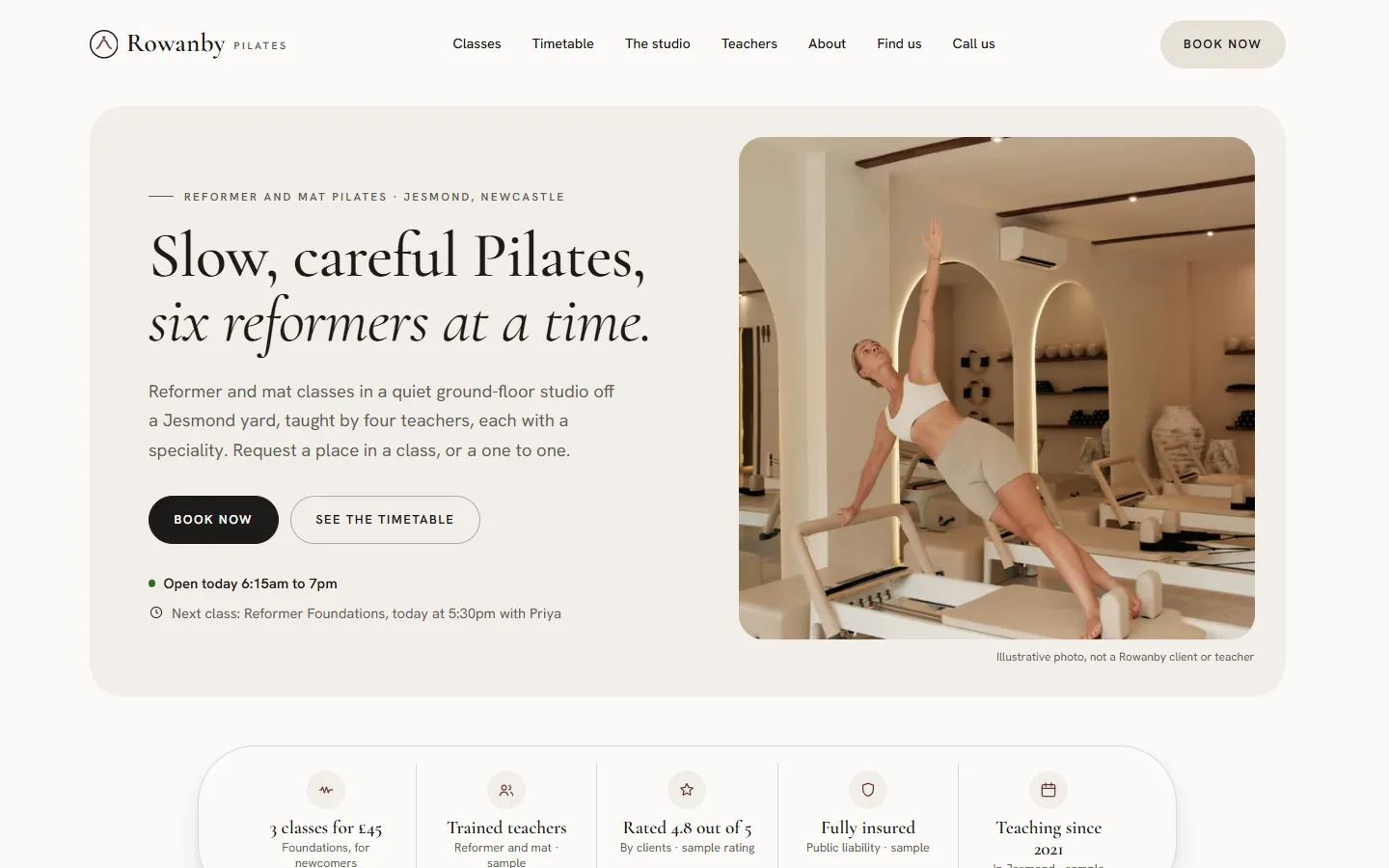
Rowanby Pilates, a demo we designed and built for pilates studios. A fictional business, with illustrative photography.
Example site
A reformer and mat Pilates studio in Jesmond, Newcastle upon Tyne
- Timetable from today
- Single classes and packs
- Class request in four steps
Demo website
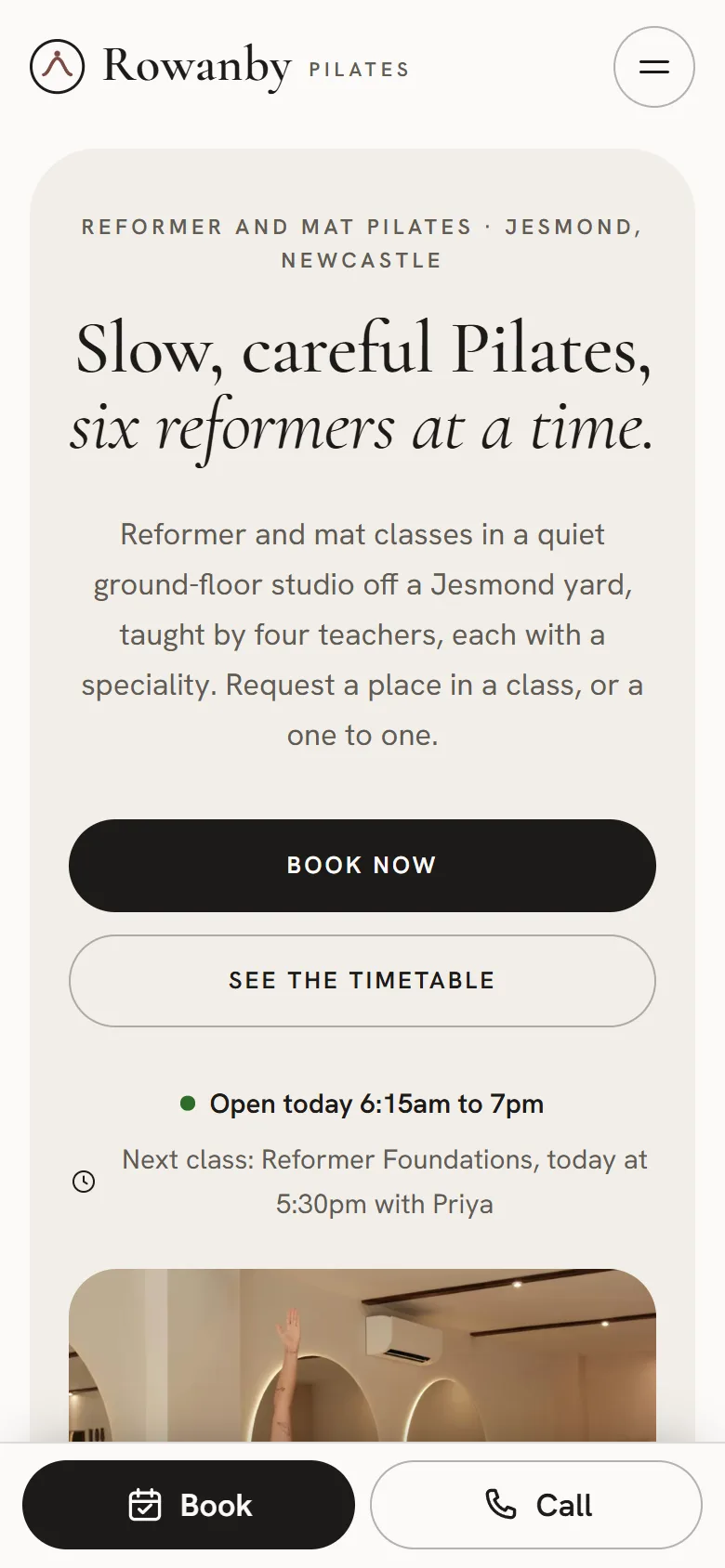
Rowanby Pilates is a fictional business. We designed and built its website as a demo of how we build for pilates studios, using illustrative photography.
Open the live demo(opens in a new tab)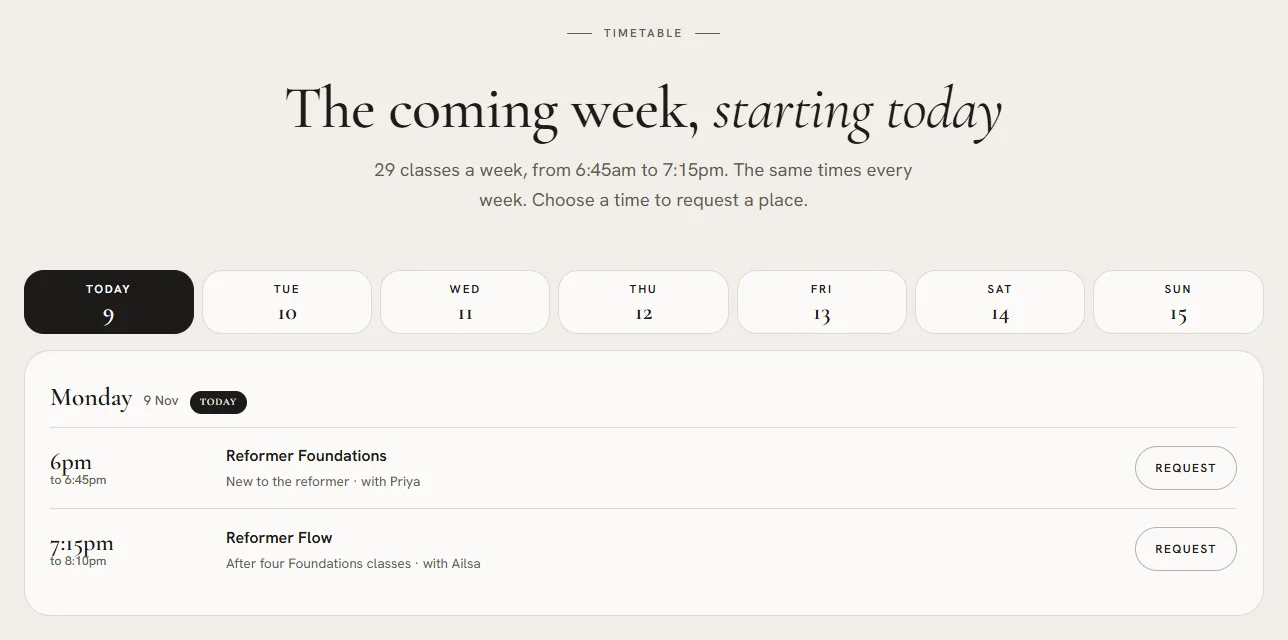
01 / Timetable
Every reformer and mat slot, from today onwards
The timetable opens on today and runs through the week, leaving out closed days, short-day gaps and classes that have started. Each slot shows its times, level and teacher and opens the class request with that class and time picked; a class starting within the hour keeps its row but loses its Request link.
Teacher on every slot
02 / Prices
Packs laid out beside the single price
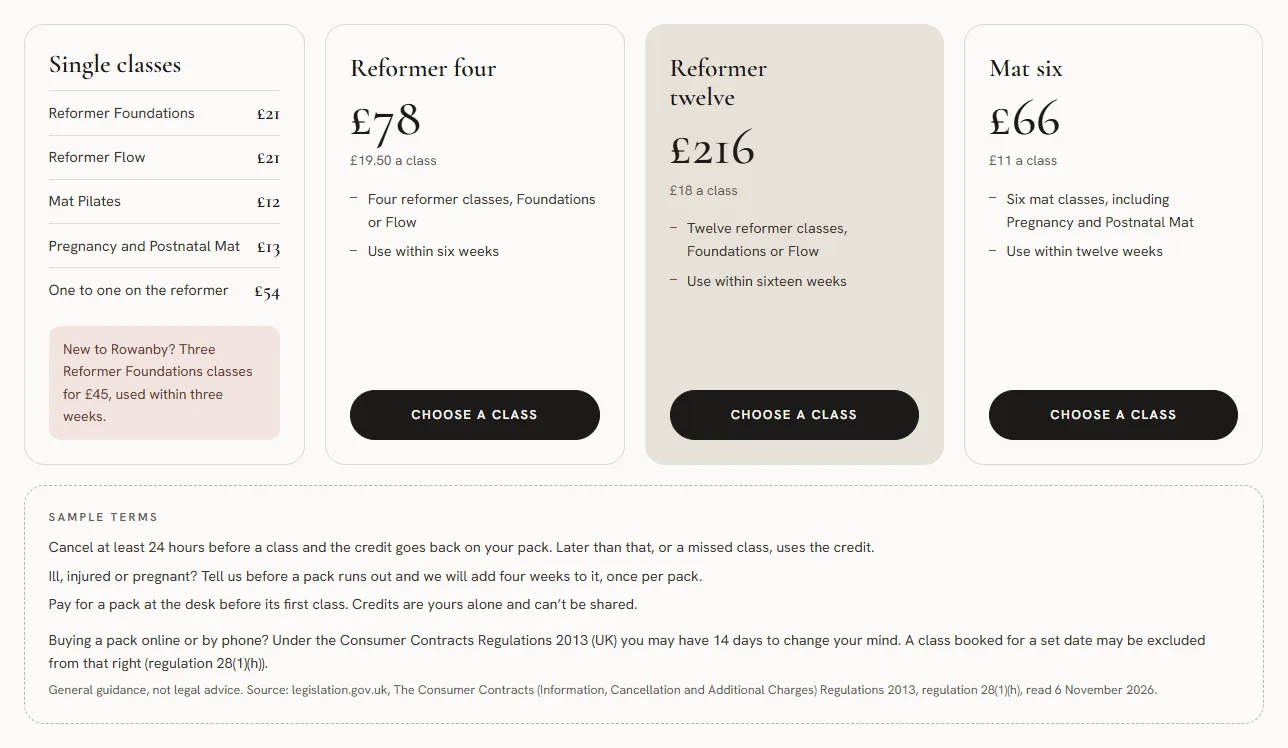
Single classes and packs sit in one place, each pack with what it costs per class, how long it lasts and the studio's terms for cancelling and missed classes written underneath, so a newcomer can compare them before paying anything.
Terms beside the price
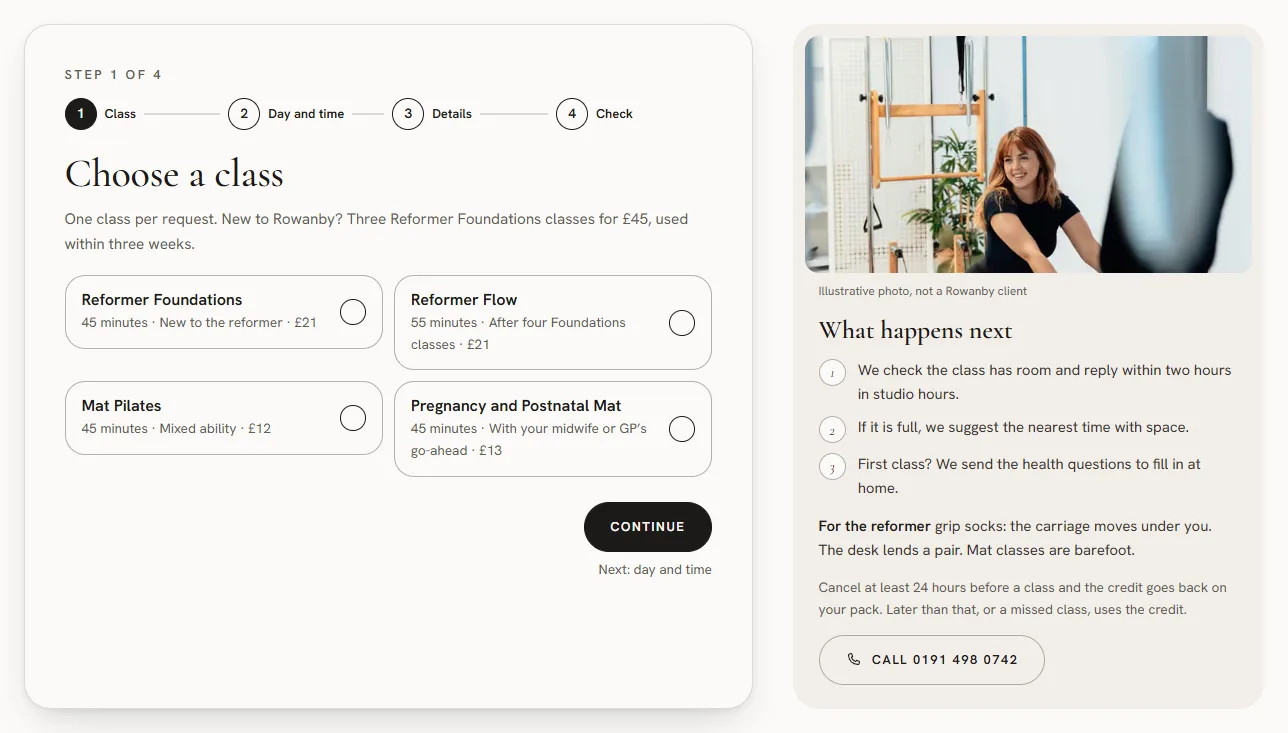
03 / Class request
Four steps, and nothing about anyone's health
The request asks for a class, a day and time, a name and one way to reply, then reads it all back and says the studio will reply to say whether there is room. Its notes box asks people not to add medical details. Four teacher profiles, marked as samples, list the classes each one runs, and Find us covers directions, parking and the step-free door.
No medical details asked
For newcomers, regulars and pregnant clients
Pilates studio website design for reformer and mat classes.
A request for a place, not a health form
Ask for the class, the time and one way to reply, and keep medical questions for a separate step. If you take payment or bookings through class software, we check how it connects and price it before quoting.
Training listed teacher by teacher
No statutory register covers Pilates teachers, so clients rely on what the website tells them. Copy each teacher's qualification title from the certificate, name who awarded it and link the training body's register where they appear.
Clinical or physio-led only when a physiotherapist teaches
Physiotherapist is a protected title across the UK; clinical Pilates is not. If a class is billed as physio-led, name the physiotherapist, give their HCPC registration number and link the register.
No promises about backs a teacher cannot keep
Under the CAP Code, a website needs evidence, usually trials on people, before it says a class relieves pain or corrects posture. Describe what happens in the class instead, and send anyone in pain to a GP or physiotherapist first.
Pregnancy classes in the NHS's words, nation by nation
The NHS website for England tells pregnant women to tell their instructor and, later on, to try to avoid lying flat on their back for more than a few minutes. NHS inform in Scotland words it differently. Quote the one that applies.
Class packs with the small print on the card
Work out the price per class for each pack, then write how many weeks it lasts, the notice for cancelling a booked class and whether credits can be shared or paused, where people read them before they buy.
Reformer, mat and pregnancy classes nearby
Reformer before work. Mat at lunch.
Pilates website design for the person comparing studios on their phone, and the one who wants to know a class is safe for their back or their bump.
Searches by kind of class
Reformer pilates near me averages about 33,100 searches a month across the UK and pilates classes near me about 18,100, against 2,400 for mat pilates near me. Splitting reformer and mat classes on the timetable matches how those searches are worded.
Searches about a body
Pregnancy pilates near me averages about 880 searches a month, clinical pilates about 320 and is pilates good for back pain about 320. Those visitors read the class description and the teacher's training closely, so both belong on the page.
Want ongoing support with Google Maps and local rankings?
Explore local SEO →Available separately from your website build.
Example local searches
- Reformer pilates near me
- Mat pilates near me
- Pregnancy pilates near me
Search counts come from DataForSEO's Google Ads data for the UK, averaged from October 2025 to September 2026 and taken on 6 November 2026.
Clear prices. Clear scope.
Fixed price. Agreed scope. No surprises.
Starter
From£295
One page for a teacher running a few classes.
- Classes, reviews and contact details on one page
- Requests for a place emailed to you and kept
- You own the site, the domain and the words
Essentials
From£595
Up to five pages for a studio with a full timetable.
- Home, classes, teachers, reviews and find us
- One tap to call the studio from any page
- Your clients' Google reviews on the site
- Most popular
Business
From£995
A page for reformer, mat and every class in between.
- Everything in Essentials
- A page each for reformer, mat, pregnancy or one to ones
- Photo galleries of the studio and its equipment
- Hosting and care for the first year
- All prices include VAT
- Hosting £15 a month, optional care £25 a month
- SEO plans from £100 a month
Business includes hosting and care for the first year. Or split any package into 12 interest-free monthly payments.
Prices last updated 24 September 2026. See full pricing and what each package includes
Your pages, features, price and timescale, agreed in writing before you pay.
How it works
From first chat to a website that works.
- 01
Brief
Tell us your classes and levels, the timetable, your packs and how cancelling works, each teacher's qualifications and who awarded them, and whether any class is taught by a physiotherapist. That becomes a written scope and one fixed price. Taking payment or bookings online through your class software is checked and priced before the quote.
- 02
Build
The timetable, the class pages, teacher profiles, the packs and their terms, the class request and the find us page, written with you. You approve every qualification line, every word about pregnancy or back pain and every price before it goes live.
- 03
Launch
We send a test request for each class, check every slot and teacher against the timetable you gave us and read the packs on a small phone. Then the site goes live, on a domain you own.
Your questions, answered
What Pilates studio owners ask us.
Need a straight answer? Speak to us.
0161 399 4054What will my fixed quote include?
Your pages, the features on them, the final price and the timescale, in writing before you pay a deposit. Hosting, care and any ongoing SEO are listed separately, so you can see what is one-off and what is monthly. On the Business package the first year of hosting and care is included.
Do Pilates teachers need a qualification, and how can clients check one?
No law requires one, but clients will look. Pilates teachers are not on a statutory register: the HCPC's list of the professions it regulates across the UK does not include them. CIMSPA, the sector's professional development body, sets its own route of a Level 3 qualification in teaching matwork Pilates followed by further courses for the reformer and other equipment, and it endorses qualifications that meet its Pilates Based Matwork Instructor standard. In England, Ofqual's register lists regulated Level 3 matwork diplomas and, from awarding organisations such as YMCA Awards and NCFE, reformer qualifications too, so a client can search the title printed on a certificate. Training schools keep lists of their own: Body Control Pilates runs a register of its teachers with their qualifications, Merrithew lists STOTT PILATES certified instructors in an online finder, and Polestar has a directory of its practitioners. Each of those is that body's own standard, not the law. On the teachers page, write each qualification the way the certificate does, say who awarded it and link the register the teacher is listed on.
Can we call a class clinical Pilates or physio-led?
Only call it physio-led if a physiotherapist teaches it. Physiotherapist and physical therapist are protected titles across the UK, and under the Health Professions Order 2001 it is an offence, with intent to deceive, to use one you are not entitled to or to claim to be on the HCPC's register when you are not. Clinical Pilates and Pilates instructor are not on the HCPC's list of protected titles, so the words are not reserved. Clients searching for clinical Pilates mostly find classes run by physiotherapy clinics, though, so the word reads as a sign that a health professional is involved. Name who teaches each clinical or physio-led class, give their HCPC registration number and link the HCPC's online register so a client can check it. If you run a physiotherapy practice with Pilates classes of its own, our physiotherapy page covers the clinic side.
Can our website say Pilates helps back pain or posture?
Only as far as your evidence goes. The CAP Code, which the ASA applies across the UK and to a business's own website, says objective claims must be backed by evidence, if relevant consisting of trials conducted on people, and that marketing must not discourage essential treatment for conditions that need medical supervision. The ASA's advice on pain claims accepts that the techniques used in physiotherapy, chiropractic and osteopathy can relieve some types of pain, and says that in almost all other cases a claim to treat or relieve pain needs documentary evidence from clinical trials. Pilates is not among the treatments it names. A line promising better posture is an objective claim as well. So describe what a class involves and who it suits, say plainly that your teachers do not diagnose or treat, and ask anyone in pain to see a GP or a physiotherapist before they start.
What can our pregnancy and postnatal class pages say?
Quote the NHS, and say which one. The NHS website for England says exercise is safe in pregnancy, that new exercise should start gently, that later in pregnancy it is best to avoid any activity that involves lying flat on your back for more than a few minutes, and that you should tell the instructor you are pregnant. Its page on the body after birth says the postnatal check at around 6 to 8 weeks is a good time to talk to the GP about problems since the birth, and, where the stomach muscles have separated, to try to avoid sit-ups, planks and high-impact exercises to start with. NHS inform, for Scotland, says to check with a midwife or physiotherapist that an activity is safe and to take care not to overstretch, because ligaments soften. The NHS sets no date from which a postnatal class is safe, so a rule such as joining after the postnatal check is your studio's own and should say so. All of this is health guidance, not law.
Is a booking for our pregnancy class health data?
It may be. The ICO's guidance on the UK GDPR, which applies across the UK, says data concerning health is special category data, that pregnancy may count in so far as it concerns a person's health, and that health can be read from details such as a list of appointments at an osteopath clinic or an invoice for a series of physiotherapy sessions. A record showing that someone attends a pregnancy, postnatal or clinical Pilates class can say something similar. The ICO adds that inferred details become special category data when you mean to draw the inference or treat the person differently because of it, such as sending pregnancy offers to everyone booked into the pregnancy class; you then need an article 9 condition as well as a lawful basis. Decide who can see those bookings and say in your privacy notice how they are used. For contact details, the demo's class request asks for a name and one way to reply, and nothing more. Health questionnaires before a first class are covered on our fitness studios page.
Let's build your next step
Want newcomers to book the right first class?
Send us your classes and levels, your timetable, your packs and their terms, and each teacher's training. You get a fixed price back in writing, with the pages listed.