Fitness website design
Fitness website design that leads with the week's classes
A class studio sells an hour in a room at a set time, so a visitor's first question is whether any slot fits their week. In the UK there are about 5,400 searches a month for fitness classes near me. Before requesting a first class, a newcomer wants to know what each class involves, who teaches it, how long it runs and what joining would commit them to. Gym website design works the same way for a small gym that runs a class timetable: the week on a phone, a request from any slot, and health questions kept for the studio, not a web form.
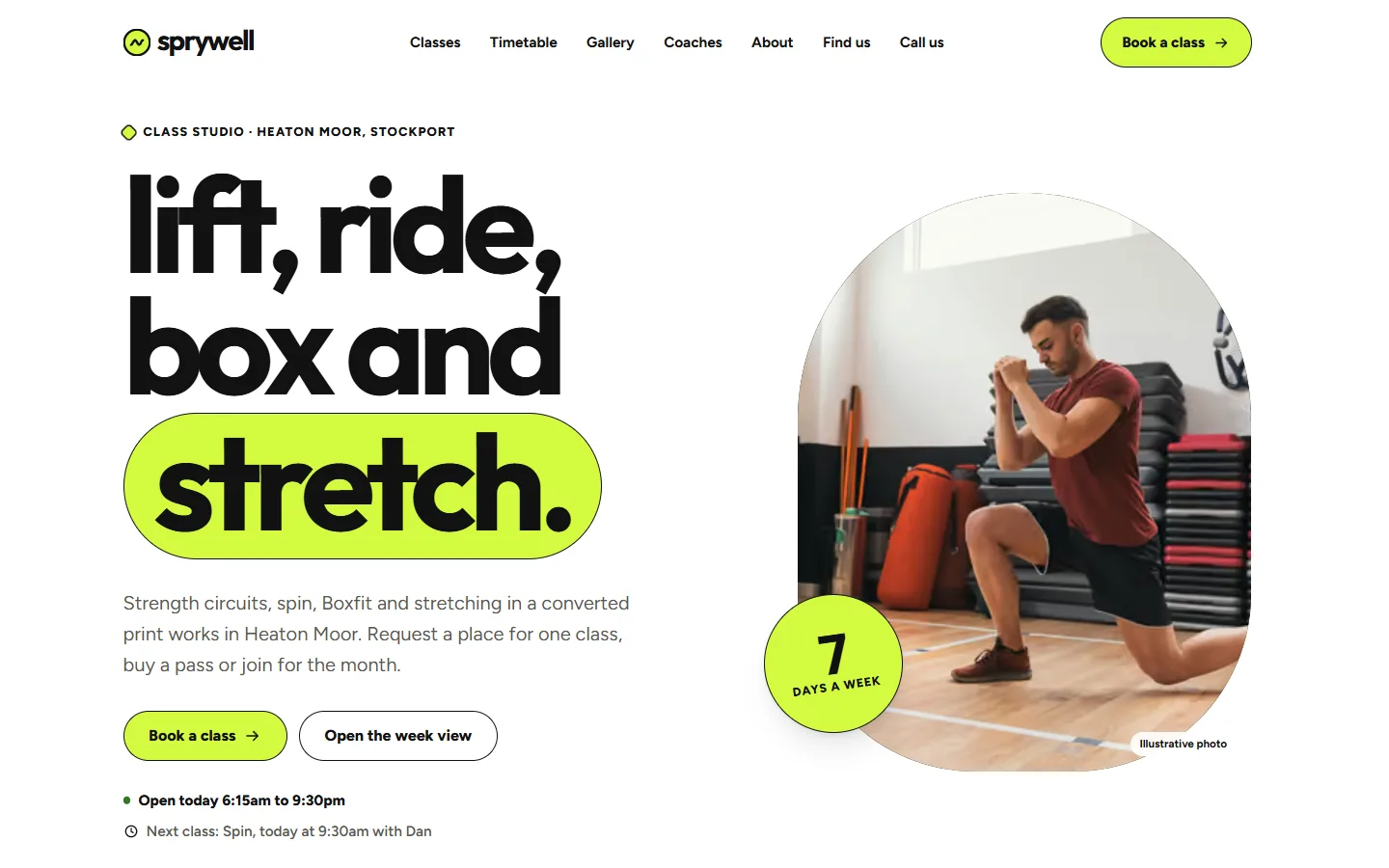
Sprywell Studio, a demo we designed and built for fitness studios. A fictional business, with illustrative photography.
Example site
A small group fitness studio in Heaton Moor, Stockport
- Seven days of classes
- Request opened from a slot
- No medical details asked
Demo website
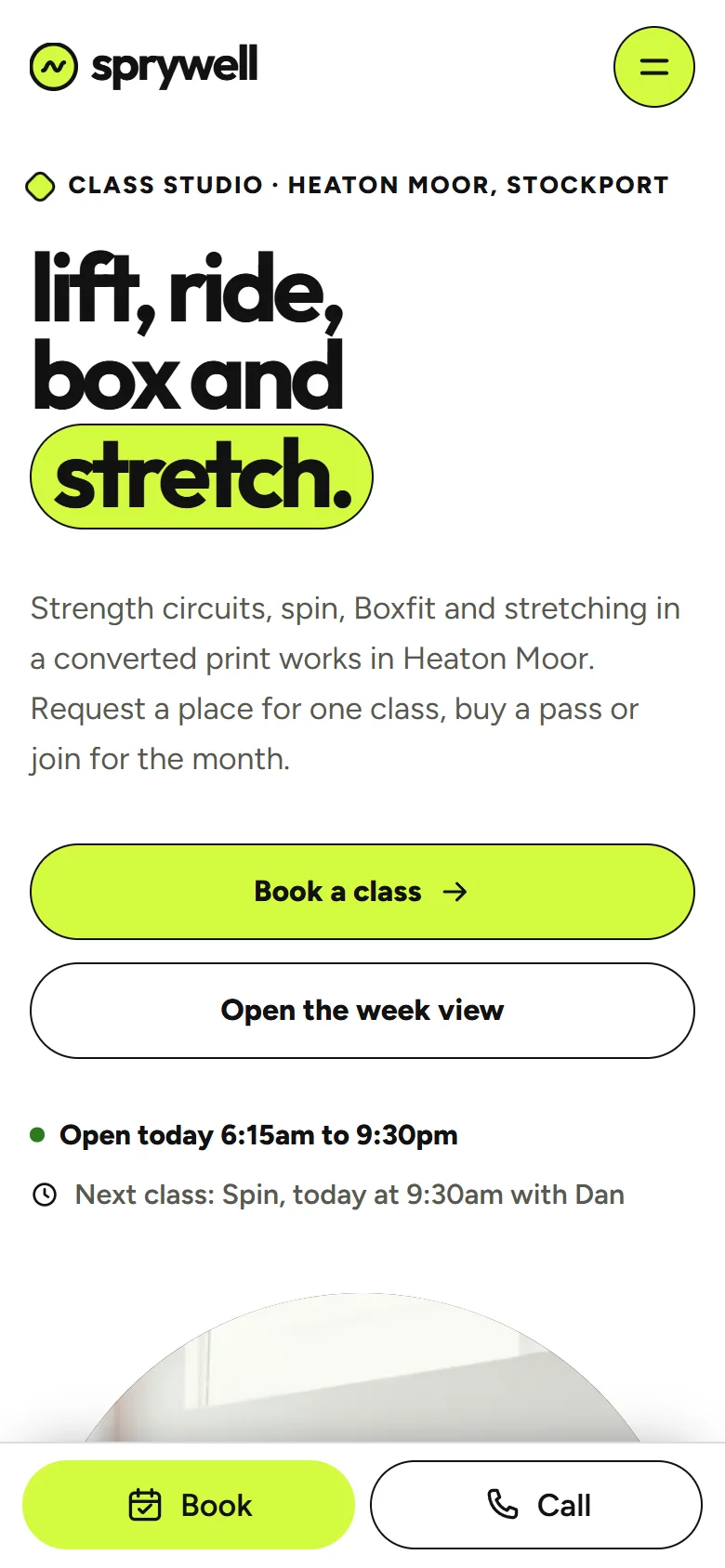
Sprywell Studio is a fictional business. We designed and built its website as a demo of how we build for fitness studios, using illustrative photography.
Open the live demo(opens in a new tab)01 / Week view
Each slot says who teaches it and for how long
The timetable sets out seven days of classes, and every slot carries the class name, the coach taking it and its length. A tap on any time starts a request with that class and that slot already picked, which saves a regular from choosing them again.
Coach and length on every slot
02 / Place request
Four short steps and nothing about health
The request runs over four screens: pick the class, pick the day and time, add contact details, then read it all back before it goes. A note on the form says medical details stay out, so health questions wait for the studio itself.
Medical details left out
03 / First visit
The questionnaire, explained before anyone arrives
A four-step explainer takes a newcomer from the request to their first class, including the health questionnaire, which the demo says 'takes about five minutes at the desk before your first class'. Coach profiles list which classes each one leads, with qualifications shown as sample lines, and a Find us page covers getting there and getting in.
Questionnaire done at the desk
For newcomers and members
Gym website design for studios that run on classes.
A week view that takes requests
Lay the week out by day with the class, the coach and the length on each slot, and let any time open a request already filled in. Taking payment online, or linking the class booking software you run now, is checked and priced before the quote.
Health questions kept off the web form
Screening is part of instructors' professional standards, and CIMSPA's gym instructor standard names the PAR-Q and PAR-Q+. Health answers are special category data under the UK GDPR, and the PAR-Q+ publisher's terms ask for written permission before it goes into a website.
Minimum terms set beside the price
The CMA's guidance on unfair terms says tie-ins of over 12 months have been found unfair, as was a 12-month tie-in with no way out after illness or losing an income. Show the minimum term, notice and any freeze next to each price.
Leaving online, if joining is online
The DMCC Act 2024 subscription rules were not in force on 4 November 2026. UK-wide draft regulations propose 1 January 2027, if Parliament approves; members who join online would then need a way to leave online too.
Coaches' qualifications in their own words
The government's register of regulated professions lists no fitness coach profession, and its CIMSPA entry reserves no activity; only the post-nominals are restricted. Name each qualification as the certificate does, who awarded it, and a CIMSPA credential where a coach holds one.
Weight-loss claims kept within the CAP Code
The ASA's advice on exercise says weight-loss claims are likely to be acceptable with evidence and alongside a calorie-controlled diet, while a set amount in a set time, such as 8lb in a month, is not permitted. Class pages say only what you can back up.
Spin, circuits and HIIT nearby
Spin before work. A circuit after it.
Fitness website design for the newcomer comparing studios on a phone, and the regular who only wants the next free slot.
Searches for a class nearby
Across the UK, spin classes near me draws around 6,600 searches in an average month, fitness classes near me around 5,400 and gym classes near me around 3,600. A class page that shows when it runs answers that search on the first screen.
Searches by type of workout
HIIT classes near me runs at about 1,300 searches a month, circuit training near me at about 1,000 and kettlebell classes near me at about 880. Naming the workout in each class title matches the words in those searches.
Want ongoing support with Google Maps and local rankings?
Explore local SEO →Available separately from your website build.
Example local searches
- Spin classes near me
- HIIT classes near me
- Fitness studio near me
Search counts come from DataForSEO's Google Ads data for the UK, averaged from October 2025 to September 2026 and taken on 4 November 2026.
Clear prices. Clear scope.
Fixed price. Agreed scope. No surprises.
Starter
From£295
One page for a coach with a few weekly classes.
- Your classes, times, reviews and contact on a single page
- Place requests sent to your inbox and saved
- Site, domain and words all belong to you
Essentials
From£595
Five pages at most, for a studio running classes all week.
- Home, classes and timetable, coaches, reviews, find us
- Google reviews from your members, shown on the site
- Tap to call the studio from any page
- Most popular
Business
From£995
A page for each class, and room for the studio itself.
- Everything in Essentials
- A page for every class on the timetable
- Photo galleries of the studio and its classes
- Hosting and care through the first year
- All prices include VAT
- Hosting £15 a month, optional care £25 a month
- SEO plans from £100 a month
Business includes hosting and care for the first year. Or split any package into 12 interest-free monthly payments.
Prices last updated 24 September 2026. See full pricing and what each package includes
Your pages, features, price and timescale, agreed in writing before you pay.
How it works
From first chat to a website that works.
- 01
Brief
Tell us your classes and when they run, who teaches each one, your prices and passes, how people join and how they leave, and what your health questionnaire asks. From that we write down the scope and a fixed price. If you want members to join, pay or cancel online, that is checked and priced before the quote.
- 02
Build
The timetable, class pages, coach profiles, prices and membership terms, the class request and the first-visit page, written with you. You approve every class description and every line about what a membership commits someone to.
- 03
Launch
We send a test request from a slot on each day, check every class time and price against the list you gave us and read the membership terms on a small screen. Only then does the site go live, on a domain you own.
Your questions, answered
What fitness studios ask us before they build.
Need a straight answer? Speak to us.
0161 399 4054What will my fixed quote include?
Your pages, the features on them, the final price and the timescale, in writing before you pay a deposit. Hosting, care and any ongoing SEO are listed separately, so you can see what is one-off and what is monthly. On the Business package the first year of hosting and care is included.
Can our health questionnaire go on the website as a form?
It can, but do not copy the PAR-Q+ into it without permission. The PAR-Q+ Collaboration, which publishes the current version, says its prior written authorisation is needed to put the questionnaire into a website, an online survey or booking software, and that a studio's own questions must not be presented as the official form. Health answers are also special category data under the UK GDPR, which applies across the UK: collecting them online needs a lawful basis and an article 9 condition, a privacy notice that says so, and no more questions than the purpose needs. Screening itself is professional practice, and CIMSPA's standards for instructors include it. The demo has the questionnaire filled in at the desk before the first class, and its request form says: 'Please don’t include medical details here.'
How long can a membership tie someone in?
Under the Consumer Rights Act 2015, which applies across the UK, an unfair term in a consumer contract does not bind the member. The CMA's guidance on unfair terms, updated in July 2026, says tie-ins of over 12 months have been found unfair because people cannot judge their circumstances more than a year ahead, and that a 12-month tie-in was held unfair where members could not leave for medical reasons or loss of livelihood; that finding comes from a 2011 High Court case against a gym management company. The same guidance treats an excessively long notice period on a membership that runs on as more likely to be unfair. On the website, put the minimum term, the notice period, any freeze and how to leave next to the price, where a member reads them before joining.
If someone joins on our website, can they cancel within 14 days?
Usually, yes. Across the UK, a membership or pass bought online or by phone is a distance contract, and the Consumer Contracts Regulations 2013 give the member until 14 days after the day it was made to cancel a service. If they asked to start training within that time and then cancel, they pay an amount in proportion to what they have had, provided you told them about the right to cancel and that cost before they were bound. Before they are bound you also tell them how long the membership lasts, how it can be ended and any minimum term. A membership signed in person at the studio desk is outside that 14-day right. Leisure services booked for a specific date are an exception, which may cover one class booked for a set time but does not obviously reach a rolling membership.
Will members have to be able to cancel on the website?
Not yet. The subscription contract rules in the Digital Markets, Competition and Consumers Act 2024 were not in force on 4 November 2026. Draft regulations laid in Parliament propose that they apply from 1 January 2027, across the UK, if Parliament approves them. The government's draft guidance says they would cover contracts that renew and charge automatically until the customer stops them, which is likely to include a rolling monthly membership, wherever the contract is signed. They would add a 14-day cooling-off period and require a straightforward way to leave; where members can join online, they would have to be able to end the membership online, through something like a clearly labelled button or a simple web form, and the draft says an email address alone is not enough. Selling or cancelling memberships online is checked and priced before the quote.
Does a studio need a music licence for its own classes?
Usually, on PPL PRS's account. It says that if you play music in your gym, fitness class or studio, the chances are you need TheMusicLicence, which covers the vast majority of commercially available music; once bought, it licenses the classes you hold on your premises. An instructor who runs classes in a church hall or community centre needs a licence of their own. The price depends on the business. PPL PRS's own example, which it dates September 2026 and we read on 4 November 2026, puts an instructor holding three classes a week for 50 weeks in a gym or studio at £702 a year, or £4.68 a class, plus VAT; a studio's own licence is priced on a quote. It also says to check that a streaming service's terms allow commercial use before playing it in a class. These are PPL PRS's policies and prices, and its licence covers the UK.
How can members check a coach's qualifications?
Through CIMSPA, where the coach is a member. CIMSPA keeps a public directory of members who hold professional status, showing each one's name, status and post-nominals with a link to a digital credential that anyone can verify. The government's register of regulated professions, which covers the UK, lists CIMSPA membership as accreditation with no reserved activities: what is restricted is its post-nominals, such as MCIMSPA, which only members who meet its requirements may use. So write each coach's qualification on the website as the certificate words it, name who awarded it, and link the CIMSPA credential where there is one. The demo's coach profiles show their qualifications as sample lines.
Let's build your next step
Want your timetable to take the requests?
Send us your classes, your coaches, your prices and how members join and leave today. A fixed price comes back to you in writing, along with what the site will contain.