Pottery studio website design
Pottery studio website design that shows each class, its dates and what it includes
A pottery class happens on a date, so the first thing a visitor looks for is one that suits them. In the UK, pottery classes near me draws about 14,800 searches a month, and whoever is searching is likely to want to know what they will make, whether a beginner will cope, what the price covers and when the pot comes home. Your website answers each of those on a phone, lists the dates every class runs, and takes a request for a place that you then confirm.

Marlpit Studio, a demo we designed and built for pottery studios and art classes. A fictional business, with illustrative photography.
Example site
A pottery and art class studio in Marple, Stockport
- Dates offered from the timetable
- Ages, length and inclusions per class
- Sample terms before sending
Demo website
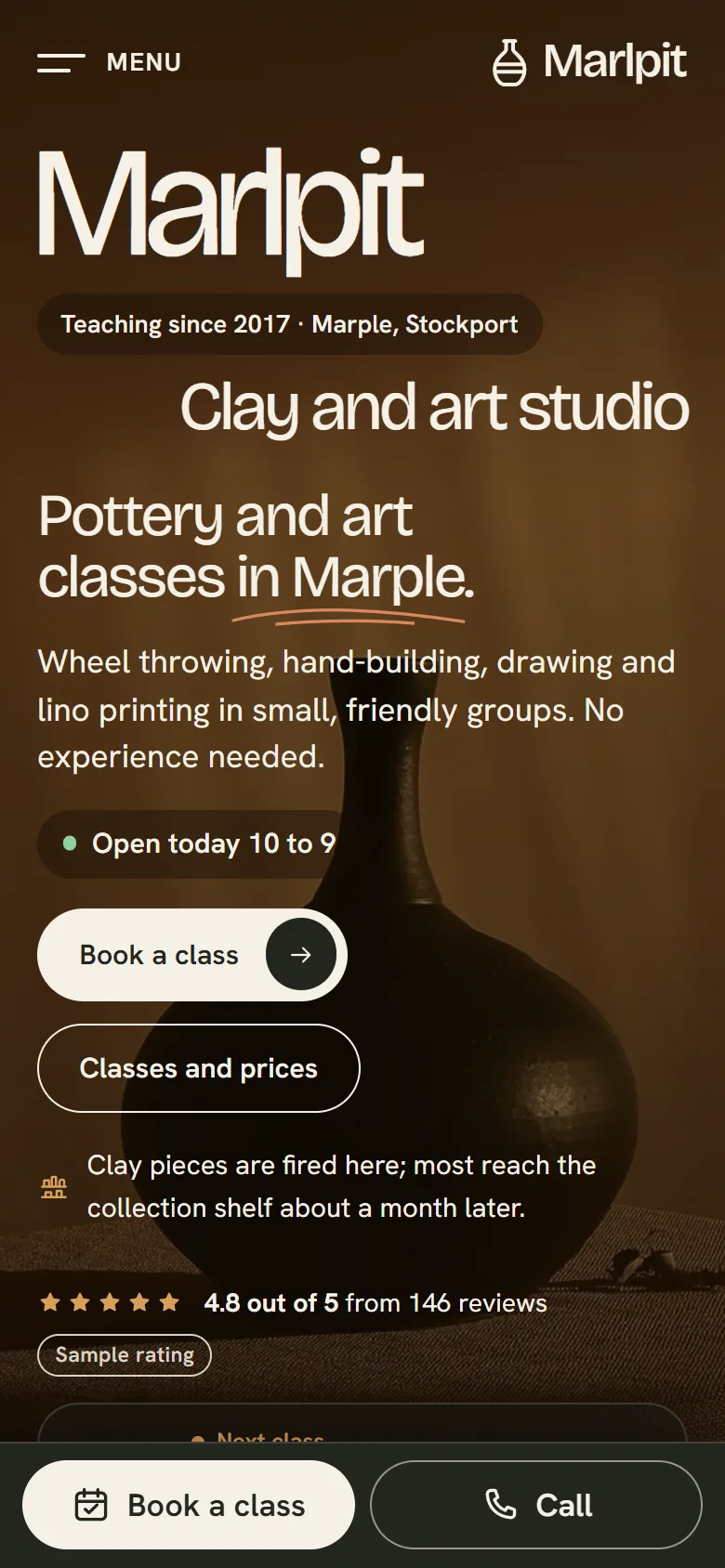
Marlpit Studio is a fictional business. We designed and built its website as a demo of how we build for pottery studios and art classes, using illustrative photography.
Open the live demo(opens in a new tab)01 / Place request
Only the dates a class really runs
Asking for a place takes four steps: pick the class, choose a date, leave contact details, then look over the request. The dates are worked out from each class's weekly times, and a course is offered only on the days a new group begins. Sample booking terms are linked from the final step.
Course start dates only
02 / Classes
Length, ages and what the price covers
Every class, at the wheel or at the table, gets a section giving when it runs, how long it lasts, how many it takes, who it is for and what is included, down to the materials and firings. A weekly timetable sets the whole week out by day, so a regular can find their slot and a newcomer can pick an evening.
Inclusions listed per class
03 / Clay and safety
Why a pot takes longer than a print
A short explainer follows a piece from the wheel to drying, the first firing, glazing and the second firing, so nobody expects to carry a mug home on the night. Next to it sit sample studio safety rules, labelled as an example, since every studio writes its own.
Sample rules, labelled
Before the first class
What a learner checks before asking for a place.
Dates drawn from your timetable
Enter each class's weekly times once and the request form offers the next dates from them, showing a course only where a new group begins. Online payment or a booking system link is checked and priced before the quote.
Cancelling, stated before anyone is bound
Across the UK, a phone or online booking normally carries a 14-day right to cancel, but leisure services booked for a set date are an exception that may cover your classes. Say which applies before the booking binds.
Vouchers with the expiry on the front
A voucher may carry an expiry date if the terms are clear and fair. The government told Parliament in 2020 it strongly encourages at least two years; print the date on the voucher and on the page that sells it.
Checks for anyone teaching children
In England and Wales, a tutor teaching children on more than three days in any 30, such as a weekly Saturday club, is eligible for an Enhanced DBS check with the children's barred list. Name only the checks your tutors hold.
Kiln and dust rules people can read
In Great Britain, HSE recommends a barrier round any kiln with accessible hot surfaces where the public come in, and its ceramics guidance says to vacuum or wet-clean dust, not brush it. Say how your studio does both.
Inclusions you can stand behind
Under the Consumer Rights Act, what a class page says about the service counts as part of the booking once a customer takes it into account. List the clay, glazes and firings in the price, and any extra charge, where they choose.
Learners and gift buyers
A first go at the wheel. A present for somebody else.
Pottery studio website design for the beginner choosing a class and the buyer choosing a gift.
Looking for a class to join
Pottery classes near me reached about 22,200 searches in January 2026, against an average of 14,800 a month, and art classes near me averages about 4,400. A class page with its next dates answers them directly.
Buying a class as a present
Pottery experience averages about 720 searches a month and pottery voucher about 70; in December 2025 they reached 1,300 and 260. A voucher page that says what it buys and how answers both.
Want ongoing support with Google Maps and local rankings?
Explore local SEO →Available separately from your website build.
Example local searches
- Art classes near me
- Pottery studio near me
- Pottery wheel class near me
Searches: DataForSEO (Google Ads, UK), 12-month averages, October 2025 to September 2026, plus the single months named; read 4 November 2026.
Clear prices. Clear scope.
Fixed price. Agreed scope. No surprises.
Starter
From£295
One page for a tutor with a class or two.
- Your classes, reviews and contact details in one place
- A place request that arrives by email and is kept
- Tap-to-call for anyone who would rather ring
Essentials
From£595
Up to five pages for a studio with a full week of classes.
- Pages for home, the classes, the studio, reviews and finding you
- Google reviews from your students, shown on the site
- A fast build that works first on a phone
- Most popular
Business
From£995
A page per class, and room to show the work.
- Everything in Essentials
- A page of its own for each class
- Galleries of glazes, prints and finished pieces
- First-year hosting and care included
- All prices include VAT
- Hosting £15 a month, optional care £25 a month
- SEO plans from £100 a month
Business includes hosting and care for the first year. Or split any package into 12 interest-free monthly payments.
Prices last updated 24 September 2026. See full pricing and what each package includes
Your pages, features, price and timescale, agreed in writing before you pay.
How it works
From first chat to a website that works.
- 01
Brief
Tell us the classes you teach, when each runs, who it suits, what the price includes, how you sell vouchers and what your booking terms say now. Scope and price are settled in writing together, and if you already take bookings or payments through a system, we check whether the site can connect to it before we quote.
- 02
Build
Class pages, the timetable, the request for a place, the voucher page, your studio rules and booking terms, written with you. Every rule, and every line about what a class includes, is yours to approve.
- 03
Launch
We send a test request for each class to see the right dates appear, compare every class page with the prices you sent us, and check the terms are linked from the final step. Then the site is published on a domain that belongs to you.
Your questions, answered
Questions class studios ask us.
Need a straight answer? Speak to us.
0161 399 4054What will my fixed quote include?
Your pages, the features on them, the final price and the timescale, in writing before you pay a deposit. Hosting, care and any ongoing SEO are listed separately, so you can see what is one-off and what is monthly. On the Business package the first year of hosting and care is included.
Can someone cancel a class they booked online or by phone?
Not always. Across the UK, booking by phone, email or an online form usually makes a distance contract, and those normally carry a 14-day right to cancel. The Consumer Contracts Regulations 2013 exclude services related to leisure activities where the contract sets a specific date or period of performance, and the government's guidance explains that the exception protects traders who set aside capacity they may not easily be able to fill or resell. Classes are not named in either, so a single class on a date, or a course whose evenings are fixed when it is booked, may fall within it. If you rely on the exception, the customer must be told before they are bound that they have no right to cancel; where the right does apply, you give its conditions, time limit and procedure, with a cancellation form. A gift voucher carries no date, so do not assume the exception reaches it. Nothing stops you being more generous, for example by letting people move to another date.
How long should a class gift voucher last?
As long as you decide, provided the terms are clear and fair. Asked in the House of Lords in January 2020, the government said it strongly encourages businesses to be transparent about voucher expiry dates, that the law lets consumers challenge unfair terms, and that where expiry dates are used it strongly encourages at least two years. Under the Consumer Rights Act 2015 an unfair term is not binding on the customer and written terms must be transparent, which the CMA explains as easy to read and understand; its guidance also says a term with a significant effect has to be brought up front. In practice, print the expiry on the voucher itself and repeat it wherever vouchers are sold, along with what one can be spent on and what happens to any balance. These rules apply across the UK.
Do the tutors at a children's clay class need a DBS check?
The law makes the right check available rather than compulsory, but a tutor who teaches children regularly qualifies for the highest level. In England and Wales, DBS guidance treats teaching children on more than three days in any 30-day period as regulated activity, and its own example is someone who teaches children every Saturday morning; that role is eligible for an Enhanced DBS check with a check of the children's barred list. It is illegal for an organisation to knowingly employ someone barred from that work. A self-employed tutor in an eligible role applies through a DBS umbrella body. Since 1 September 2026 the exemption for supervised work has gone, so a helper working alongside the tutor every week may be in regulated activity too. Scotland and Northern Ireland have their own checks, through Disclosure Scotland and Access NI. On the website, name exactly the checks your tutors hold.
Does a children's clay club need to register with Ofsted?
In England, usually not, on Ofsted's guidance as updated in October 2026. Most childcare for children under 8 must be registered, but tutoring or coaching in one or two kinds of activity, arts and crafts among them, for children aged 3 and over is exempt, as long as the activity is the main focus and the aim is for the children to improve their skills; for children aged 3 to 5, it covers less than 4 hours in any one day. Offer a third kind, such as sport or performing arts, and the exemption no longer applies. Separately, a provider who looks after each child for less than 2 hours a day cannot register at all, unless it is before or after school care, and children aged 8 and over can only be registered voluntarily. This is England's rule, with the exemptions set by the Childcare (Exemptions from Registration) Order 2008; a studio in Wales, Scotland or Northern Ireland should check with its own nation's childcare regulator.
What should the website say about kilns and clay dust?
What your own assessment of the studio decided, in plain words, so people know what to wear and what to expect. In Great Britain, HSE's guidance on kilns in schools and craft studios recommends a protective barrier, such as a metal cage, for any kiln with accessible hot surfaces in a studio the public are admitted to, with operating and emergency instructions near each kiln. Its guidance for the ceramics industry notes that clay, slip and glazes contain crystalline silica, that dust settled on surfaces and clothing gets back into the air, and that dust should be vacuumed or cleaned wet rather than brushed. The demo shows rules like these as a short list, marked as a sample a real studio replaces with its own. A studio in Northern Ireland should check with its own regulator, since this guidance covers Great Britain.
Does what my class page says count as part of the booking?
Yes, once the customer takes it into account. Under the Consumer Rights Act 2015, anything you say or write about the service that a customer takes into account when booking is treated as a term of the contract, together with any qualification you gave at the same time. So 'clay, glazes and firings included' is a promise, and 'usually ready within a month' is a different promise from 'ready within a month'. For a booking made at a distance, the Consumer Contracts Regulations also require the total price, and any extra charges or the fact that there may be some, before the customer is bound. Put what each class includes, and any extra such as clay beyond an allowance, on the class page itself. These rules apply across the UK.
Let's build your next step
Ready to put your classes and their dates online?
Tell us which classes you teach, the days they run and what each price covers. You get a fixed quote in writing, listing the pages and features it includes.