Websites for roofers & roofing contractors
Roofing website design for urgent repairs and re-roof quotes
Roofing website design has to handle work that arrives in two moods. After a windy night it is a homeowner on the driveway, phone in hand, looking up at a gap in the tiles and ringing the first roofer who looks genuine; the rest of the year it is a flat roof or a full re-roof being priced by three firms, sometimes with an insurer waiting on a written quote. We build roofing websites that handle both: tap-to-call and a storm-damage route at the top, a page for each kind of roof work, and your NFRC or CompetentRoofer membership linked to the register so a cautious homeowner can check you are real in seconds.
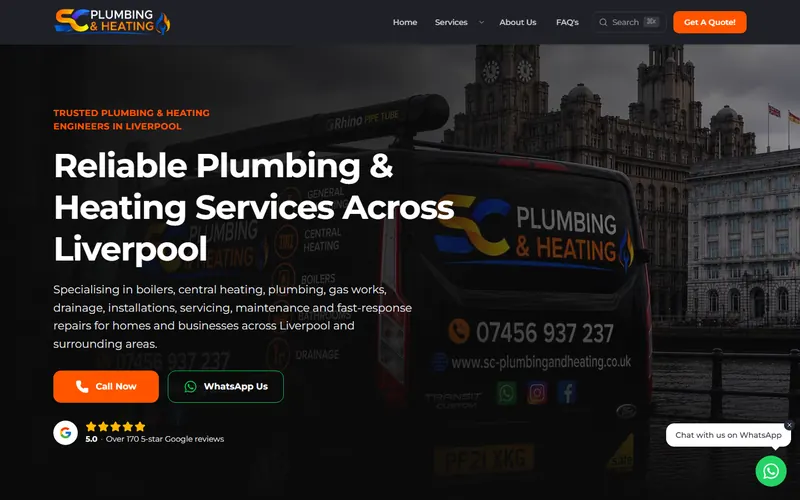
SC Plumbing & Heating, built by JW Digital Services Ltd. Not a roofer site: we have none to show yet, and this is the same build.
Why a generic site lets you down
What a roofer's customers actually do
After the storm
They search on a phone. Then call the first roofer they trust.
The searches after high winds are 'roof repair near me' and 'emergency roofer' plus the town, typed on a phone while staring at slipped tiles or a spreading ceiling stain.
The decision is made in a minute, on a small screen. A number hidden under a slideshow, or a page still loading on a poor signal, is a call that went to the next result.
Fast pages. A phone number within reach.
The trust check
They check you are genuine before they call.
Ask Google about roofing websites and it offers 'How can you tell a dodgy roofer?' as a follow-up question, with the NFRC's guide to choosing a contractor on the same page. So the homeowner is checking rather than browsing: trade-body membership, insurance, a real address, photos of finished roofs nearby.
The cold-caller who knocked after the last storm has made them wary of everyone, and a site with stock photos and a mobile number fails that check in seconds.
Show proof customers can check.
Repairs and replacements
A leak needs a call today. A re-roof needs comparison.
Repairs are urgent and go to whoever answers. Replacements, a full re-roof, a flat roof that has finally given up, new fascias and gutters, are shopped around over days, and where storm damage is being claimed for, the insurer generally wants a written report and quote before anything happens.
A single 'roofing services' page gives the urgent customer no number to tap and the careful one nothing to compare, so it loses both.
Clear routes for urgent calls and planned quotes.
Built for the trade
What we build into every roofer website
A storm-damage route at the top of every page
Tap-to-call in the first screen, with a short 'leak or storm damage' path that says what you need from them: the address, what is happening, and a photo if they can take one safely from the ground. If you take out-of-hours calls the site says so; if you don't, it says when you do answer, because a missed 7am call after a gale is the most expensive kind.
A page for each kind of roof work, in the words homeowners use
Roof repairs, full re-roofs, flat roofs by material (felt, GRP fibreglass, EPDM rubber, single-ply), fascias, soffits and guttering, chimney repointing and leadwork, moss removal. Someone searching for a flat roof replacement lands on the flat roof page with flat roof photos, not on a homepage that mentions everything once.
Trade-body membership and insurance where a wary homeowner looks
NFRC or CompetentRoofer, CORC, TrustMark and your public liability cover shown beside the phone number, each linked to the register so they can check you in under a minute. NFRC members pass an inspection before joining, are inspected every three years after, and must evidence employers' and public liability cover, if you have been through that, the site should make it count. Your insurance-backed guarantee is explained in plain words rather than left as a footer link.
Before-and-after galleries labelled with the job and the town
A photo of a slate re-roof three streets away does more than any paragraph, so each job type gets its own gallery, captioned with what was done and where. Roof photos are big and there are a lot of them, so they are compressed and loaded as the visitor scrolls, keeping the page quick on a phone on the driveway.
A quote form that asks what you would ask on the phone
Address, roof type, what has happened (leak, storm damage, planned replacement), how urgent it is, whether an insurer is involved, and photos of the damage. You can triage before you get the ladder off the van, and an insurance job is flagged as one before you visit. Each enquiry lands in your inbox and is kept on record, so a phone left on a scaffold does not lose you the job.
The towns you cover, stated the way you actually cover them
Roofers travel different distances for different jobs: a slipped tile is worth a few miles, a full re-roof with a fortnight of scaffold is worth thirty. So the site names the towns you will go to for a repair and, separately, the wider area you will price a replacement in, so the site and your Google Business Profile's service area say the same thing. Real coverage only: no run of near-identical town pages, which a homeowner sees through as fast as Google does.
A proper place for your accreditations
Badges your customers look for, shown where they look, with a link to the register so they can check.
- NFRC (National Federation of Roofing Contractors)
- CompetentRoofer
- Confederation of Roofing Contractors (CORC)
- TrustMark
- Which? Trusted Trader
- SPRA (Single Ply Roofing Association)
- LRWA (Liquid Roofing and Waterproofing Association)
- Lead Contractors Association (LCA)
- Checkatrade
Getting found locally
How customers find a roofer
Roofing searches are local and come in bursts: 'roofer near me' and 'roof repair' plus a town climb after high winds and heavy rain, nearly all of it on a phone with Google's map results at the top of the screen. The map spots for your towns go to roofers with a well-kept Google Business Profile, reviews that keep arriving through the quiet months, and a website with a real page for each roofing job and each area. The site we build is that last part done properly; staying in the map all year is separate, ongoing work.
Already have a site?
Getting into the map is SEO, which is a separate service from the build and priced on its own.
See SEO for roofers →Built around your specialism
Flat roofing and roofline specialists
Flat roofing
A page for every material.
Homeowners search for the material a surveyor or a neighbour has told them they need.
Felt, GRP fibreglass, EPDM rubber and single-ply each get their own page, their own photos and their own guarantee wording.
SPRA or LRWA membership shown where you hold it.
Roofline specialists
A page for every product.
Fascias, soffits and guttering get a page per product, built around the roofline work you do.
Show the colours and finishes you actually fit, so homeowners can find the specific options they are looking for.
'Anthracite fascias' is a search too.
Proof
Websites we've built for roofers
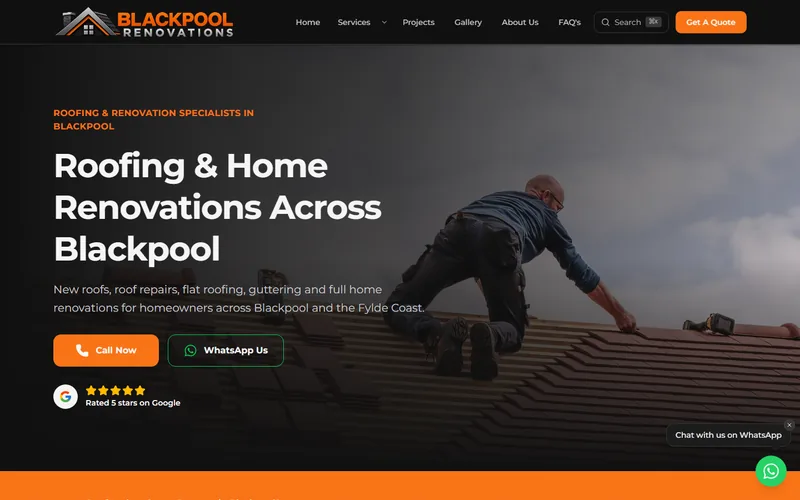

Concept design · Blackpool and the Fylde Coast
Blackpool Renovations
A concept design for a roofing and renovation firm on the Fylde Coast. It is a design, not a live client site, so the phone number, the review badge and the project write-ups on it are placeholders.
It shows the storm damage route above the fold with tap to call and WhatsApp side by side, a page for each kind of roof work, roofline and renovations, and a projects section the firm fills in itself.
Built by JW Digital Services Ltd
See the design ↗
What's included
Fixed price, fixed scope, no surprises
- Phone-first design, tap-to-call on every screen
- A page for each service you want to win work for
- Your reviews and accreditations built in
- Quote-request form that emails you and keeps a record
- Fast, mobile-first, made to rank locally
- You own the site, the domain and the content
Know the price before you call → see our packages
How it works
- 1
Tell us about the work you want more of
Three quick questions, your trade, your current site, how to reach you. You get a fixed price and a timescale back.
- 2
We build it around how your customers buy
The storm-damage route and tap-to-call go in first, then a page for each kind of roof work you want more of, then your badges, guarantee and job photos, and you sign off each page before it is published.
- 3
Go live, then get found
Hosting, care and (if you want it) SEO so the site keeps earning its keep. No lock-in: it's yours.
Questions
Roofers ask us
How do you know if a roofer is good?
Homeowners are told to look for trade-body membership, proof of insurance, a written quote and photos of finished roofs, and the NFRC inspects its members before they join and every three years after, so the badge means something. Your website should answer all of that before anyone asks: the badge linked to the register, the insurance stated, the guarantee explained in plain words, and real before-and-after photos with the town named. A homeowner who can confirm it in a minute on their phone has stopped comparing you with the cold-caller.
I'm flat out after every storm, why do I need a website?
Because storm weeks fill the diary with small repairs, and the quiet months are carried by re-roofs, flat roofs and roofline jobs that get shopped around, and those customers check you out online before they ring, even when a neighbour recommended you. The site is where the recommendation gets confirmed: the work, the badges, the guarantee, the towns you cover. It also lets a homeowner claiming on their insurance send you the details and photos without a phone call in the middle of your busiest fortnight.
Can I just use a free roofing website template?
You can, and for a one-van firm with work coming in by word of mouth it may do for now. Where templates let roofers down is the parts that win the job: a storm-damage route that works on a phone, accreditations linked to the registers, galleries that do not crawl, a page for each roof type, and someone to fix it when the platform changes its terms or you find the domain belongs to them. What we build is yours outright, the domain, the pages and every photo on them.
How much does a roofing website cost?
One fixed figure, given before any deposit changes hands, and for a roofer it mostly moves with photos and pages: how many kinds of roof work get their own page and gallery, whether you want a separate storm-damage route and an insurance-claims page, and how many towns you cover. Galleries are the roofing-specific cost, because roof photos are big and there are a lot of them, and handling them so the page stays quick on a phone is part of the build rather than an extra. The packages on our pricing page list what is in each; what UK trade websites usually cost, and why two quotes for the same site can be so far apart, is in our cost guide.
Can the site handle insurance-claim enquiries?
Yes. The quote form asks whether an insurer is involved, so you know a written report and an itemised quote are needed before you visit, and the photo upload lets you see the damage before you price it. A short page explaining how you work with insurers after storm damage, what you provide, what they need from the homeowner, how long a report takes, reassures someone who has just been through it and separates you from the roofer who only does cash jobs.
Can I see roofing websites you've built?
Not a roofing one yet. The trade sites we can point you to today are a decorator, a landscaper, a groundworks contractor and a Liverpool plumbing and heating firm; JW Digital Services Ltd, which runs this site, built all four, and we will happily walk you through what would change for a roofing business. If you are browsing 'best roofing websites' galleries for ideas, judge them by what wins a roofing job rather than the animation: a number you can tap in the first screen, a storm-damage route, a page per roof type, the trade-body badge linked to the register, and photos captioned with the town.
Know the price before you call
Tell us your trade, the towns you cover and what you've got online now. You'll get a fixed price and a timescale in writing.
We reply within one working day.