Websites for plasterers & renderers
Websites for plasterers and renderers, built for a search made on a phone
Plastering is booked from a phone, usually by someone standing in a room they have just stripped. They search for a plasterer near them, and Google answers with a map of three businesses before a single website. Your profile gets you into that map; your site is what turns the person reading it into a booked job, and it is where the questions they ask next get answered.
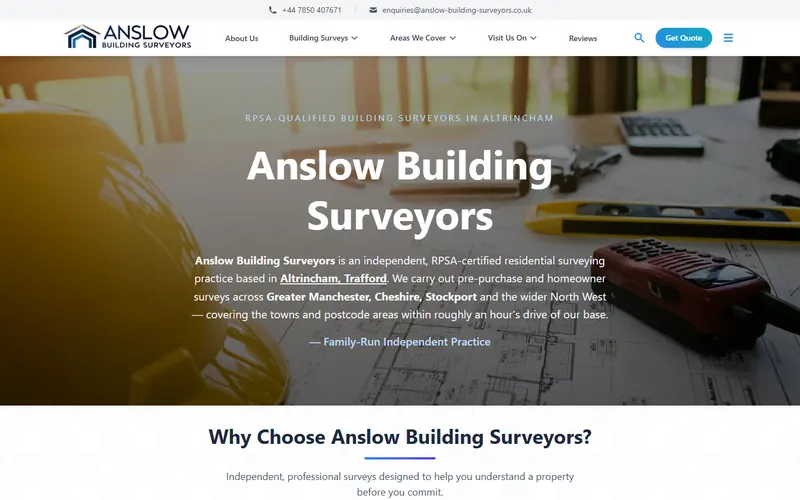
Anslow Building Surveyors, built by JW Digital Services Ltd. Not a plasterer site: we have none to show yet, and this is the same build.
Why a generic site lets you down
What a plasterer's customers actually do
The map decides it, and most of the firms in it have no site
'Plasterers near me' and its variants are searched around 14,800 times a month in the UK. When we checked that search in September 2026, Google showed a map of three plastering firms above every organic result, and only one of the three had a website link next to it. Two had reviews in the dozens and a phone number and nothing else. That is the gap: they are being found, and then judged on a phone number alone.
A comparison site is quoting your hourly rate for you
Under the map, page one is Checkatrade, Yell, MyBuilder, Airtasker and a price-comparison site that publishes plasterers' hourly rates by town. Every question Google lists under 'people also ask' is about money: what you should pay a plasterer, what they charge an hour, what they get a day, whether skimming is cheaper. If your site does not answer those, the comparison sites do it for you, and they price on an average.
The questions after the quote are all about mess and drying
How long until it is dry. When can it be painted. Do you take the old plaster away. Will the house be full of dust. Nothing on page one of that search answers any of it, so the plasterer answers it on the phone, every time, for every job they quote. It belongs on the site once, in writing.
Built for the trade
What we build into every plasterer website
A page for each job, not one page called services
Skimming and re-skims over artex, boarding and dot-and-dab, patching and repairs, rendering, external wall insulation and floor screed. They are different jobs with different prices and different customers, and someone who wants a ceiling re-skimmed should not have to read about render systems to find out whether you do it.
Rendering treated as its own business
'Renderers near me' runs at about 2,400 a month and carries the highest advertiser cost of any search in this trade, which tells you what those jobs are worth. Rendering also sells differently: system choice, colour, scaffolding, lead times and what happens to the beading round windows. It gets its own pages and its own photographs rather than a line on a plastering page.
Drying and decorating times, written down
A short, plain section saying how long fresh plaster needs before it can be painted, what mist coat means, and what the customer needs to move or cover. It answers the call you would otherwise take, and it is the kind of specific, useful content that thin competitor pages never carry.
How you price, before they ring
Per room, per wall or per square metre, day rate for larger jobs, and what changes it: ceiling work, artex, how much making good, access and scaffolding on render. You do not have to publish a fixed price list to be clearer than a comparison site quoting an average by the hour.
Finish photographs that survive a phone screen
Plastering photographs badly. Flat light on a finished wall shows nothing, so the galleries are built around the same room before, boarded and finished, and around the details people judge: clean internal angles, tidy reveals, a straight bead line. Photographs from your own jobs, captioned with the room and the town.
A page title that says who you are and where
One independent plastering firm on page one of that search has 'Email us' as its page title, which is the blue headline Google shows to everyone who sees it. Titles, headings and the business details are set properly on every page we build, because it is the cheapest thing on this list and the most commonly wasted.
A proper place for your accreditations
Badges your customers look for, shown where they look, with a link to the register so they can check.
- FIS (Finishes and Interiors Sector)
- TrustMark
- Which? Trusted Trader
- Public liability insurance
- Your render system manufacturer's installer scheme, where you are on one
Getting found locally
How customers find a plasterer
Plastering is won inside the map. The near-me searches run to roughly 14,800 a month in the UK, with rendering another 2,400, and Google puts three local businesses above the results every time. Those places go to firms with a complete Google Business Profile, a steady flow of reviews, and a site with a real page for each job and each area covered. Demand also swings hard through the year, from about 8,100 in December 2025 to 22,200 in October (DataForSEO, UK, checked 23 September 2026), so the work you want in season belongs at the top of the home page.
Already have a site?
Getting into the map is SEO, which is a separate service from the build and priced on its own.
See SEO for plasterers →Drylining and contract work
If your work comes from main contractors, developers and shopfitters rather than homeowners, the site has a different reader. That means pages about drylining, partitions and ceilings, the size of team you can put on site, programme and phasing, how you price by the square metre, your insurance limits, RAMS and the cards the contractor asks for, and how you invoice against valuations and retention. FIS, which describes itself as the member organisation representing the finishes and interiors sector, is the badge that audience recognises. Almost no plastering site speaks to them at all.
Proof
Websites we've built for plasterers
We haven't published a plasterer site as a public example yet. Ask and we'll walk you through comparable trade sites we've built.
See all example sites →What's included
Fixed price, fixed scope, no surprises
- Phone-first design, tap-to-call on every screen
- A page for each service you want to win work for
- Your reviews and accreditations built in
- Quote-request form that emails you and keeps a record
- Fast, mobile-first, made to rank locally
- You own the site, the domain and the content
Know the price before you call → see our packages
How it works
- 1
Tell us about the work you want more of
Three quick questions, your trade, your current site, how to reach you. You get a fixed price and a timescale back.
- 2
We build it around how your customers buy
We start with the jobs you want more of, whether rendering is part of the business, and the areas you cover, then the drying and preparation answers you repeat on the phone, and you sign off each page before it goes live.
- 3
Go live, then get found
Hosting, care and (if you want it) SEO so the site keeps earning its keep. No lock-in: it's yours.
Questions
Plasterers ask us
What should I put on the site about my prices?
The basis, and what moves it. Every question Google lists under 'people also ask' for 'plasterers near me' is about money: what to pay a plasterer, what they charge an hour, what they earn a day, whether skimming is cheaper than plastering. A comparison site on that same page answers all of it with hourly averages by town. Saying whether you price by the room, the wall, the square metre or the day, and what makes a job dearer, puts the answer on your site instead. If you are working out your own figure, our day rate calculator starts from what you want to take home.
Is skimming cheaper than plastering, and should the site explain it?
Yes to explaining it, because Google lists it as one of the questions people ask on this search. A skim over sound plaster is a different job from boarding a stripped wall or a full re-plaster, and the customer often does not know which they need. A short page for each, with a photograph of that job in progress, means the enquiry arrives with the right words in it and you spend less time on the phone working out what is actually there.
How do I show up in the map rather than the listings?
The map is a different result from the blue links. It goes to businesses with a complete Google Business Profile in the right categories, a steady flow of reviews, and a website with genuine pages for the work and the areas. The site supports the profile rather than replacing it. Nobody can promise you one of those three places, because Google fills them partly on how close you are to the person searching, and that changes street by street.
Do I need separate pages for rendering?
If you want render work, yes. 'Renderers near me' is its own search at roughly 2,400 a month, the jobs are bigger, and the questions are different: system, colour, scaffolding, lead time and what happens at the beads and reveals. Google lists 'local plasterers and renderers near me' as a related search, so people do look for both together, but the work still sells better on its own page with its own photographs.
Can I see a plasterer's website you have built?
Not a plastering one yet. The trade sites we can show you today are a groundworks contractor, a plumbing and heating firm in Liverpool, a decorator in South Manchester, a landscaper and a loft and extension builder, all built by JW Digital Services Ltd, which runs this site. They are on our examples page, and we are happy to talk through what changes for plastering, where the job pages and the drying answers do most of the work.
Know the price before you call
Tell us your trade, the towns you cover and what you've got online now. You'll get a fixed price and a timescale in writing.
We reply within one working day.