Websites for electricians & electrical contractors
Websites for electricians that turn searches into EICRs, rewires and EV installs
Websites for electricians should be built around the jobs customers search for: a landlord who needs an EICR before a tenancy starts, a homeowner whose board keeps tripping, a driver who wants a charger on the wall before the new car arrives. Each is searching for something specific and rings the first electrician who looks registered, local and reachable. Our web design for electricians is built around those jobs: a page for each, your NICEIC or NAPIT registration where they look for it, and tap-to-call on every screen.
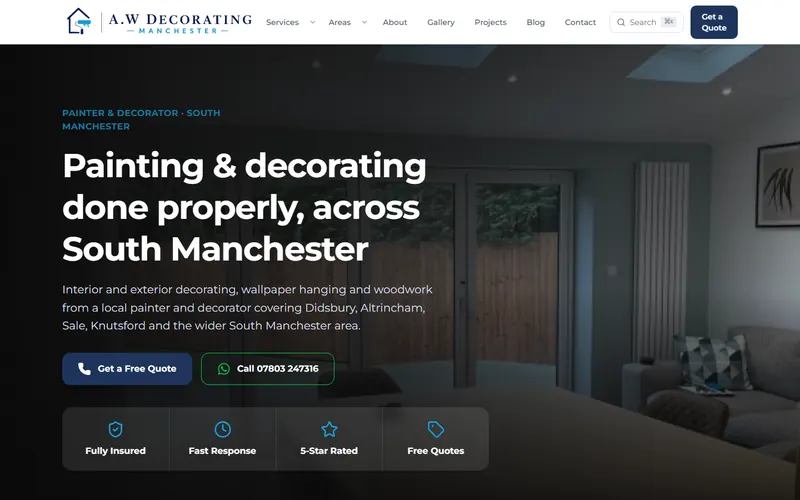
Adam Woods Decorating, built by JW Digital Services Ltd. Not an electrician site: we have none to show yet, and this is the same build.
Why a generic site lets you down
What an electrician's customers actually do
They check you're registered before they ring
Homeowners have been told to use a registered electrician, and landlords and letting agents have to. They look for the NICEIC or NAPIT badge and a registration number they can check on the register. A site that buries it in the footer, or shows no registration at all, loses them to the next result, usually a directory profile or a competitor whose badge is in the header.
Landlords and agents are buying paperwork, not electrics
A private landlord in England needs a satisfactory EICR at least every five years and has to give the tenant a copy. They search 'EICR [town]', want to know turnaround, what happens if the report comes back with C1 or C2 codes, and whether you'll do the remedials. 'All electrical work undertaken' answers none of that, so they book whoever has a page that does.
The EV charger customer wants three answers before they ring
A driver with a delivery date for the car searches for an installer by town and has questions before the call: can the supply and the earthing take a charger, who deals with the network operator, and is the price with the making-good or without. They will photograph the meter cupboard if the site asks them to. A page that says 'EV chargers installed' and nothing else loses them to the dealership's national installer, whose page answers all three on the first screen.
Built for the trade
What we build into every electrician website
A page for every electrical job you want more of
EICRs and landlord certificates, consumer unit upgrades, full and partial rewires, EV charger installation, fault finding, commercial work, emergency call-outs, each on its own page with its own phone-first call to action. Nobody types 'electrical contractor'; they type the job, so the job needs a page.
Your registration shown where customers look
NICEIC, NAPIT or your Part P scheme badge in the header and beside the quote form, with your registration number and a link to your entry on the register so they can check it in ten seconds. Public liability insurance stated plainly. Never a generic badge, always your number.
Tap-to-call plus a quote form that asks for the board
Emergency visitors get one tap to your number. Everyone else gets a short form: property type, job, postcode and a photo of the consumer unit or meter position. A picture of the board answers half the questions you would otherwise ask on the phone, so you quote faster and turn up prepared.
A landlord and letting-agent route
A section that speaks to compliance buyers: what an EICR covers, typical turnaround, how C1, C2 and C3 observations are handled, and a way for an agent to book several properties in one go. Agents who find the paperwork painless come back with the rest of their portfolio.
Pages for the areas you actually cover
A page for each town or district you work in, built from what you know about it: the 1960s estate where every other house still has its original wiring, the terraces with no driveway where a charger is a different job, the blocks of flats that keep letting agents ordering EICRs. Customers search 'electrician [town]' and 'EV charger installer [town]', and a page that could only have been written by someone who works there is where those searches should land, never one page with the place name swapped.
Proof: tidy boards, finished installs and reviews with the job in them
Before-and-after consumer units, chargers on driveways, the certificate you hand over. Your Google reviews pulled onto the site and grouped by job type, so a landlord reading about EICRs sees EICR reviews. Photos are compressed to load fast on a phone on a building site.
A proper place for your accreditations
Badges your customers look for, shown where they look, with a link to the register so they can check.
- NICEIC
- NAPIT
- ECA
- SELECT
- Part P Registered Competent Person
- ECS card
- TrustMark
- Which? Trusted Trader
- OZEV-authorised installer
Getting found locally
How customers find an electrician
Nearly all the electrical work that comes from Google comes from local searches, 'emergency electrician near me', 'EICR' plus a town, 'EV charger installer' plus a town, and from the Map Pack that sits above the results for them. Google decides those on your Google Business Profile, whether your trading name, address and number match your NICEIC or NAPIT register listing and the directories, your reviews, and whether the site has a page for the service and the area being searched. The site we build gives you those pages, fast and structured; keeping them ranking is separate, ongoing work.
Already have a site?
Getting into the map is SEO, which is a separate service from the build and priced on its own.
See SEO for electricians →Electrical contractors and commercial work
Commercial buyers do not tap a phone number at 9pm. Facilities managers, landlords with a portfolio and main contractors look for testing and inspection, emergency lighting and fire alarm work, and the accreditations they are told to check, CHAS, SafeContractor, Constructionline, before they send a tender or a pre-qualification questionnaire. If that is part of your business, we build a commercial section with a projects page, your accreditations and a named contact alongside the domestic pages, or a commercial-only site that never mentions fuse boxes.
Proof
Websites we've built for electricians
We haven't published an electrician site as a public example yet. Ask and we'll walk you through comparable trade sites we've built.
See all example sites →What's included
Fixed price, fixed scope, no surprises
- Phone-first design, tap-to-call on every screen
- A page for each service you want to win work for
- Your reviews and accreditations built in
- Quote-request form that emails you and keeps a record
- Fast, mobile-first, made to rank locally
- You own the site, the domain and the content
Know the price before you call → see our packages
How it works
- 1
Tell us about the work you want more of
Three quick questions, your trade, your current site, how to reach you. You get a fixed price and a timescale back.
- 2
We build it around how your customers buy
We start with the jobs you want more of, EICRs, boards, rewires, EV points, commercial, and build a page for each, with your registration number, your photos and a quote form that asks for a picture of the board. Every page is checked by you before it goes anywhere near Google.
- 3
Go live, then get found
Hosting, care and (if you want it) SEO so the site keeps earning its keep. No lock-in: it's yours.
Questions
Electricians ask us
Can I get a free website for my electrical business?
You can, the free builders will give you a page with their branding on it, on a subdomain you do not control, with no room for a page per service. The cost shows up later: slow mobile pages, no proper place for your registration, and a domain you cannot take with you when you outgrow it. If cash is tight, a small site you own with an EICR page and tap-to-call will do more than a free page with everything on it.
Do you use a template or build it from scratch?
We build on our own tried structure for trade sites, phone-first layout, service pages, area pages, quote form, and then write every page for your business: your jobs, your registration number, your towns, your photos. A template on its own does not win work because it does not know that a landlord searching for an EICR wants turnaround and remedials explained, or that an EV customer wants to send a photo of the board.
What should an electrician's website include?
A home page with your registration number, the areas you cover and a tap-to-call button that stays visible on a phone. Separate pages for EICRs, consumer unit upgrades, rewires, EV charger installation, fault finding and any commercial work. A page for each town you serve, your reviews, photos of finished jobs, and a quote form that asks for the property type and a photo of the board. Our guide on what a tradesman website should include goes through each item.
Who owns the website, the domain and the content?
You do. Compare that with the subscription model near the top of Google for 'websites for electricians': one agency charges a £250 set-up fee and then £48 a month for hosting, maintenance and updates, 'no long-term contracts', and says nothing on its page about who owns the site when you stop paying (checked 28 August 2026). Ours is a one-off build: the domain goes in your name, the site and its content are yours, and if you ever leave our hosting we hand over the files. Hosting and care is a separate plan you can cancel.
Have you built a website for an electrician before?
Not one we can show publicly yet. The trade sites we can show are for a Gas Safe plumbing and heating firm, a groundworks contractor, a landscaper and a decorator, all built by JW Digital Services Ltd, the company behind Websites for Tradespeople. Ask and we will walk you through them and explain what changes for an electrical business: registration proof, the EICR route and the quote form.
Do you build websites for electrical contractors as well as sole traders?
Yes. A one-van domestic electrician and a contractor bidding for commercial work need different sites: the first is phone-first with EICR, board and EV pages; the second needs accreditations, a projects page and a named contact for tender enquiries. We build either, or a domestic site with a proper commercial section, see the contractors section above.
Know the price before you call
Tell us your trade, the towns you cover and what you've got online now. You'll get a fixed price and a timescale in writing.
We reply within one working day.