Dog training website design
Dog training website design that shows your method before the first session
Dog training website design has a particular job: to explain how you train before anyone books. Puppy training near me is searched about 5,400 times a month in the UK. A trainer's site has to answer the questions that follow: which programme fits the dog, what it costs, whether you come to the house, and what you will never put on their dog. Yours sets that out on a phone, then takes a consultation request that starts with the owner's goal.
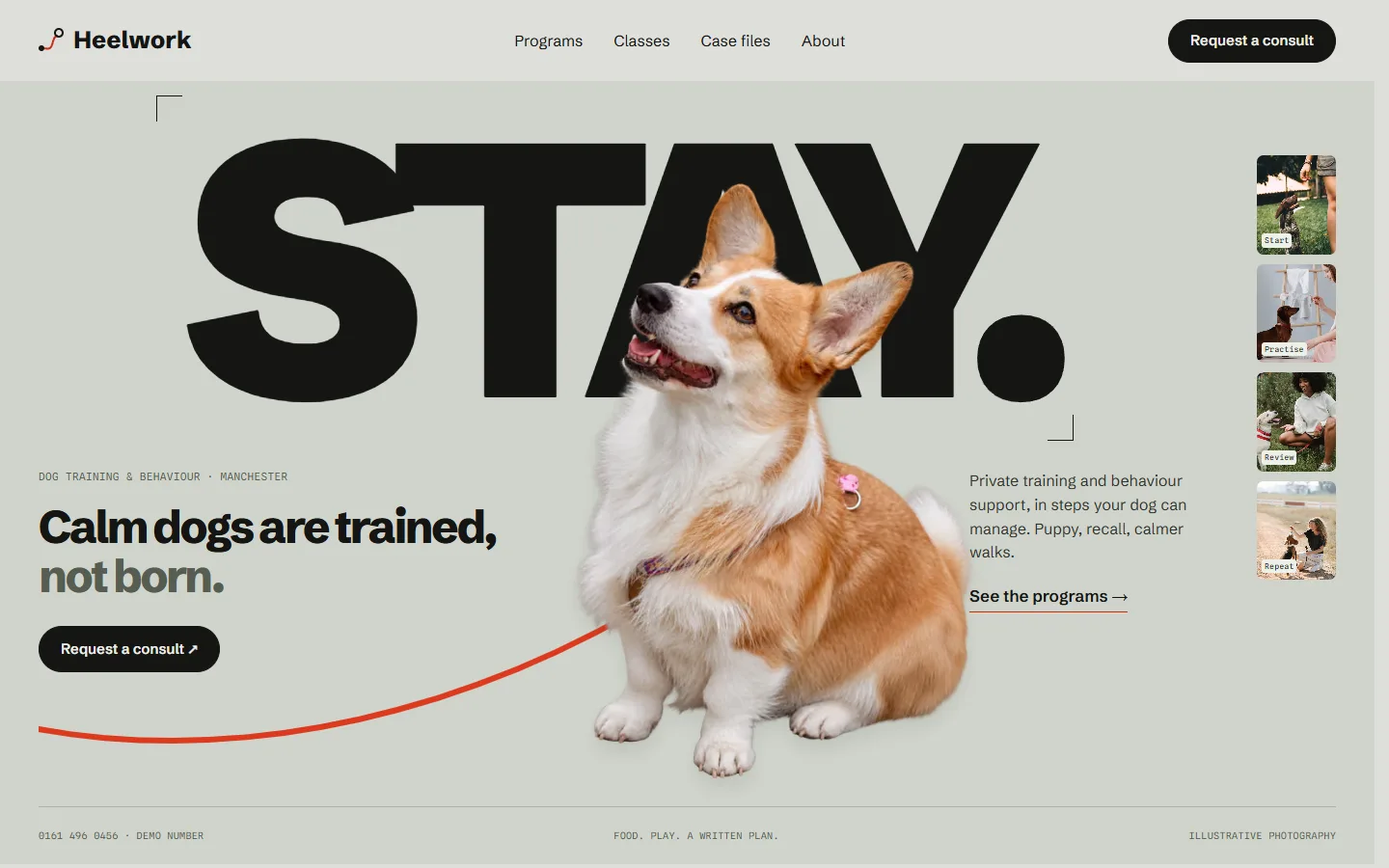
Heelwork, a demo we designed and built for dog trainers. A fictional business, with illustrative photography.
Example site
Training and behaviour support in Manchester, built around a written plan
- Four programmes, a page each
- A written plan between sessions
- Vet first for behaviour changes
Demo website
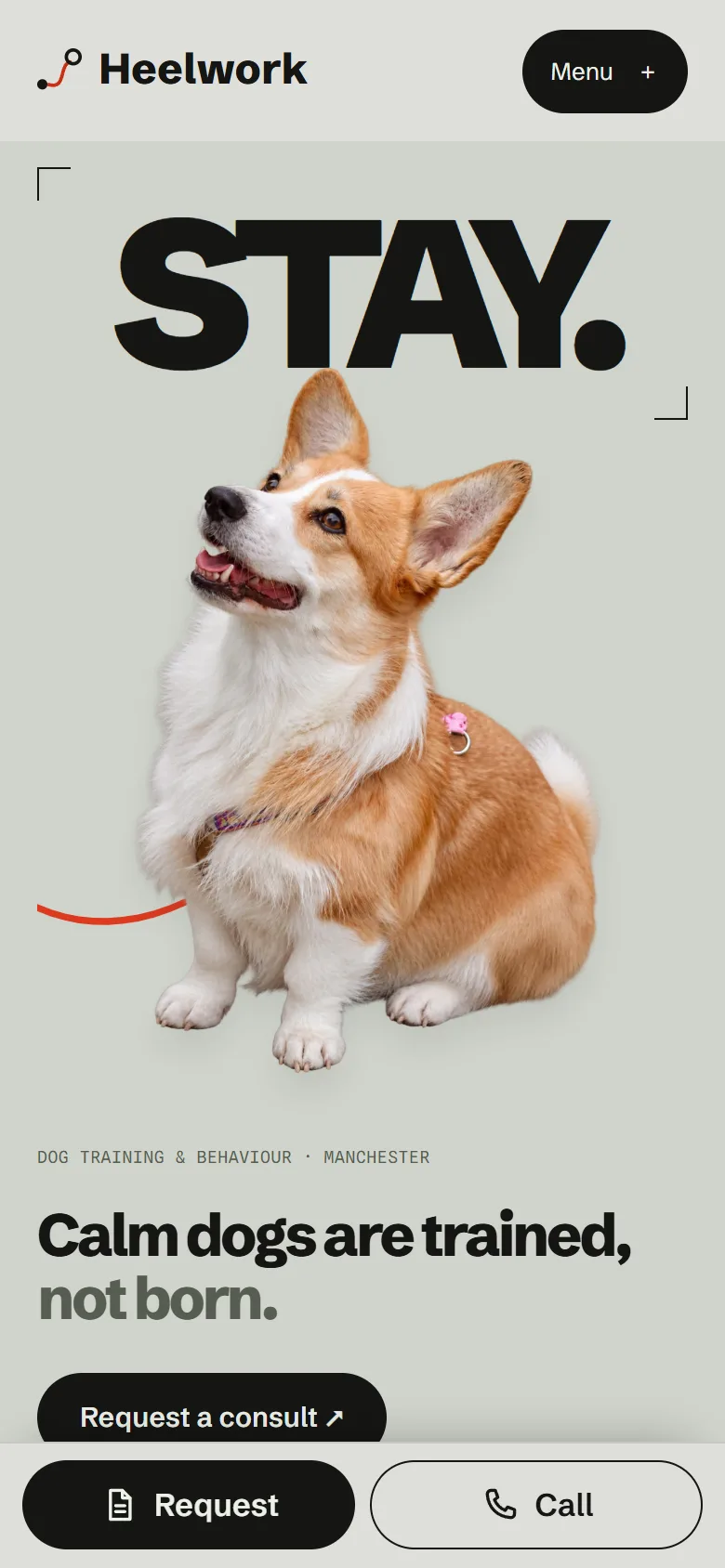
Heelwork is a fictional business. We designed and built its website as a demo of how we build for dog trainers, using illustrative photography.
Open the live demo(opens in a new tab)01 / Programmes
Price each programme, then say what moves the price
Puppy Start, Recall, Calm Walks and Loose-lead walking each have a page covering what the sessions work on, with a sample from-price. The fees page lists the first consultation and a follow-up with their length, and says the scope, the number of sessions and any travel charge are agreed with each owner.
Scope agreed before booking
02 / The plan
Show the record, including the week it went backwards
Sample learning records show the setting, the exercise, what the dog managed and the homework. One steps back a stage after a busier morning, and three fictional case files follow a puppy, a recall and a lead-walking plan from the brief to the next adjustment.
No outcome claimed
03 / Method and scope
Name the equipment, and send health worries to the vet
The trainer's profile sets out the method: food, play, comfortable equipment, no prong, choke or electronic collars. Every page tells owners to speak to their vet about a sudden change, a new fear or a bite, and the FAQ answers 'Can you guarantee a result?' with a plain no.
Vet-first line on every page
What owners look for
What owners read before they trust a trainer with their dog.
A consultation request that starts with the goal
Owners choose what they want help with and leave one way to reply, and the form asks them to keep veterinary details back until you answer. Nothing is confirmed until you have talked. Booking or video call software is checked and priced before the quote.
Your method in plain words
Say what you use and what you never will: rewards, a harness and long line, no electronic collars. Wales has banned shock collars on dogs since 2010; England, Scotland and Northern Ireland have not, so your own line is what tells owners.
Qualifications named exactly
In England and Wales the titles trainer and behaviourist are not protected, so specifics carry the weight: the course, who assessed you, and an ABTC post-nominal such as ABTC-ATI only if you are on that register.
Behaviour cases that go via the vet
Diagnosing disease or injury is for registered vets in UK law, and ABTC behaviourists take cases on veterinary referral. A short line sending a sudden change, pain, a new fear or a bite to the vet keeps your pages inside your scope.
Home visits and where sessions happen
Name the areas you visit, say when a session works best at home and when outdoors, and state that travel and any extra fee are agreed first. The demo lists five example areas on a single page.
Classes after a suitability chat
Say how many dogs a class takes and that you talk before placing a dog, and publish dates only when you have them. The demo shows no class timetable and treats every class request as a conversation.
Found by dog owners nearby
Puppies, recall, reactive walks. Each with a page that explains it.
Dog training website design for owners comparing trainers, behaviourists and puppy classes on a phone.
Searches for a trainer nearby
Dog trainer near me is searched about 2,900 times a month in the UK, and puppy classes near me about 4,400. A page for each programme, puppy classes included, gives those searches somewhere to land.
Searches about behaviour
Dog behaviourist near me runs at about 2,900 searches a month, and reactive dog training at 1,300. Behaviour work is where your scope and the vet-first line matter most.
Want ongoing support with Google Maps and local rankings?
Explore local SEO →Available separately from your website build.
Example local searches
- Dog trainer near me
- Dog behaviourist near me
- Reactive dog training
Search figures: DataForSEO, Google UK, 12-month averages to September 2026, checked 3 November 2026.
Clear prices. Clear scope.
Fixed price. Agreed scope. No surprises.
Starter
From£295
One page for a trainer starting out.
- Programmes, fees and how to reach you, all on one page
- A consultation request, emailed to you and stored
- Tap-to-call on every screen
Essentials
From£595
Up to five pages for a working trainer.
- Home, programmes, about you, reviews and contact
- The qualifications and registers you hold, where owners look
- Google reviews from your own clients
- Most popular
Business
From£995
A page for every programme and the places you visit.
- Everything in Essentials
- A page for each programme you run
- Home visit area pages, built properly
- Case files that show your process
- All prices include VAT
- Hosting £15 a month, optional care £25 a month
- SEO plans from £100 a month
Business includes hosting and care for the first year. Or split any package into 12 interest-free monthly payments.
Prices last updated 24 September 2026. See full pricing and what each package includes
Your pages, features, price and timescale, agreed in writing before you pay.
How it works
From first chat to a website that works.
- 01
Brief
Tell us the programmes you run and how you price them, the areas you visit, whether you teach classes, what equipment you will and will not use, and the qualifications and registers you hold. We agree the scope and a fixed price.
- 02
Build
Programme pages, your trainer profile, the plan and case file pages, fees, areas and the consultation request, written with you. Every qualification is named as you hold it, and you sign off each page.
- 03
Launch
We send a test consultation request, check every register entry you name, and read the method and vet lines on a phone, then publish on a domain registered to you.
Your questions, answered
Questions trainers and behaviourists ask us.
Need a straight answer? Speak to us.
0161 399 4054What will my fixed quote include?
Your pages, the features on them, the final price and the timescale, in writing before you pay a deposit. Hosting, care and any ongoing SEO are listed separately, so you can see what is one-off and what is monthly. On the Business package the first year of hosting and care is included.
Do I need a licence or a qualification to work as a dog trainer?
This answer covers England and Scotland. In England, no licence covers training pet dogs for their owners. The 2018 animal licensing regulations list five activities, and the one that touches training is keeping or training animals for exhibition as a business, such as dogs for filming or public displays. A government-commissioned taskforce reported in September 2026 that in England the titles trainer and behaviourist are not protected and the sector regulates itself; it recommended exploring regulation. In Scotland, the Scottish Animal Welfare Commission found no legal requirement for those who train dogs to have formal training. If you train in Wales or Northern Ireland, check with your council before you start. Either way, your website carries the evidence: the course, who assessed you, and any register you are on. Boarding dogs is different and does need a licence, as our boarding kennels page explains.
What do the ABTC titles mean on a trainer's website?
They tell an owner what kind of help you give, and each is yours to use only if you are on that register of the Animal Behaviour and Training Council, a voluntary scheme. An Animal Training Instructor teaches owners, in classes for example; an Animal Trainer trains the animal directly; an Animal Behaviour Technician gives preventive and first-aid behaviour advice and carries out plans a behaviourist has set; a Clinical Animal Behaviourist works on veterinary referral, as does an Accredited Animal Behaviourist, whose register is now closed to new practitioners; and a Veterinary Behaviourist is a clinical behaviourist who is also a vet. Joining a register means being assessed to the ABTC's standard for the role and being a full member of one of its practitioner organisations, and registered practitioners may use post-nominals such as ABTC-ATI. Owners can search the ABTC directory by species, type of practitioner and county.
Are electric shock collars banned, and what can my website say about them?
It depends on the nation you work in. In Wales, attaching a collar designed to give an electric shock to a cat or dog, or being responsible for a cat or dog wearing one, has been an offence since March 2010. England has no ban in force: regulations drafted in 2023 were never made, and the government's animal welfare strategy for England, published in December 2025, commits to consult on whether to ban them. Scotland has no ban either; its 2018 guidance does not condone them, and notes that causing unnecessary suffering is an offence, which may include suffering caused by inappropriate training methods. In Northern Ireland their use is not prohibited, and DAERA, the agriculture department, consulted in 2026 on banning handheld e-collars, choke collars and prong collars. Wherever you work, a plain line such as the demo's 'no prong, choke or electronic collars' tells owners what you use.
Can a dog training website promise results?
Only what you can prove. A trainer's own website comes under the CAP Code, which requires documentary evidence, held before publishing, for claims consumers are likely to read as objective, and 'reliable recall in four sessions' would be one. CAP's advice on guarantees adds that marketers who cannot guarantee certain results should be careful not to imply they can. The ABTC's advertising guidelines for its members put it plainly: support claims with facts and do not create unjustified expectations. The demo answers 'Can you guarantee a result?' with no, then explains that goals are agreed, progress observed and the plan adapted.
Should my website tell owners to speak to their vet first?
For behaviour work, yes. Across the UK, diagnosing disease or injury in an animal is part of veterinary surgery, which the Veterinary Surgeons Act 1966 restricts to registered vets, and the ABTC points to the link between some medical conditions and behaviour. Its clinical and accredited behaviourists take cases only on veterinary referral, and ask owners who contact them directly to speak to their vet first; an email or a phone call between vet and behaviourist can be the referral. A line like the demo's, sending a sudden change, a new fear or a bite to the vet, keeps the website inside your scope. Your profile can then say how you work with vets.
Which package suits a trainer working alone, and which a practice with classes?
A trainer with two or three programmes and one area fits Starter, from £295, on a single page with a consultation request. Add a method page, your profile and the areas you visit and you are in Essentials, from £595, over five pages. A practice running classes, behaviour support and several programmes fits Business, from £995, with a page for each programme and each area. Those prices include VAT, and the pricing page lists what each package contains; we put one fixed price in writing before you pay.
Let's build your next step
Want owners to understand your method before they call?
Send us your programmes, your fees, the areas you visit and the qualifications you hold. We reply with a fixed price and what the site will include.