Dance studio website design
Dance school website design that matches every dancer to a class and a trial lesson
A parent looking for a dance school starts with two questions: is there a class for my child's age, and can we try one first? Google UK sees about 27,100 searches a month for dance classes near me. Adults ask the same thing about their own evening class. A dance school website answers both on a phone, with each style broken into age groups, the week's classes and a short trial lesson request, and keeps the term fees, exams and show arrangements where families can read them before they commit. For a teacher working alone from a hired hall, dance teacher website design follows the same pattern on a single page.
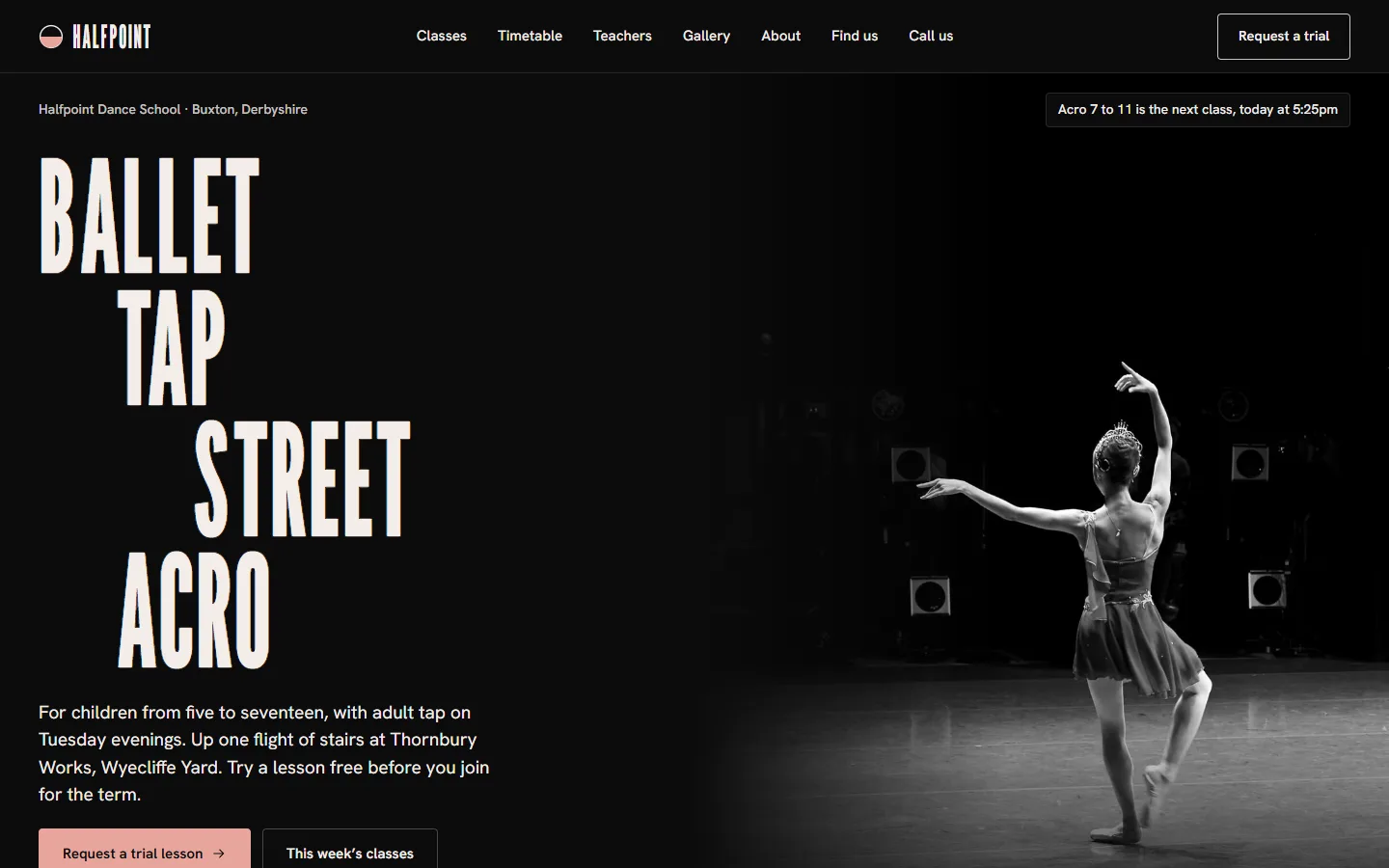
Halfpoint Dance School, a demo we designed and built for dance schools. A fictional business, with illustrative photography.
Example site
A ballet, tap, street and acro dance school in Buxton, Derbyshire
- Classes by style and age
- A week view from today
- Trial request in five steps
Demo website
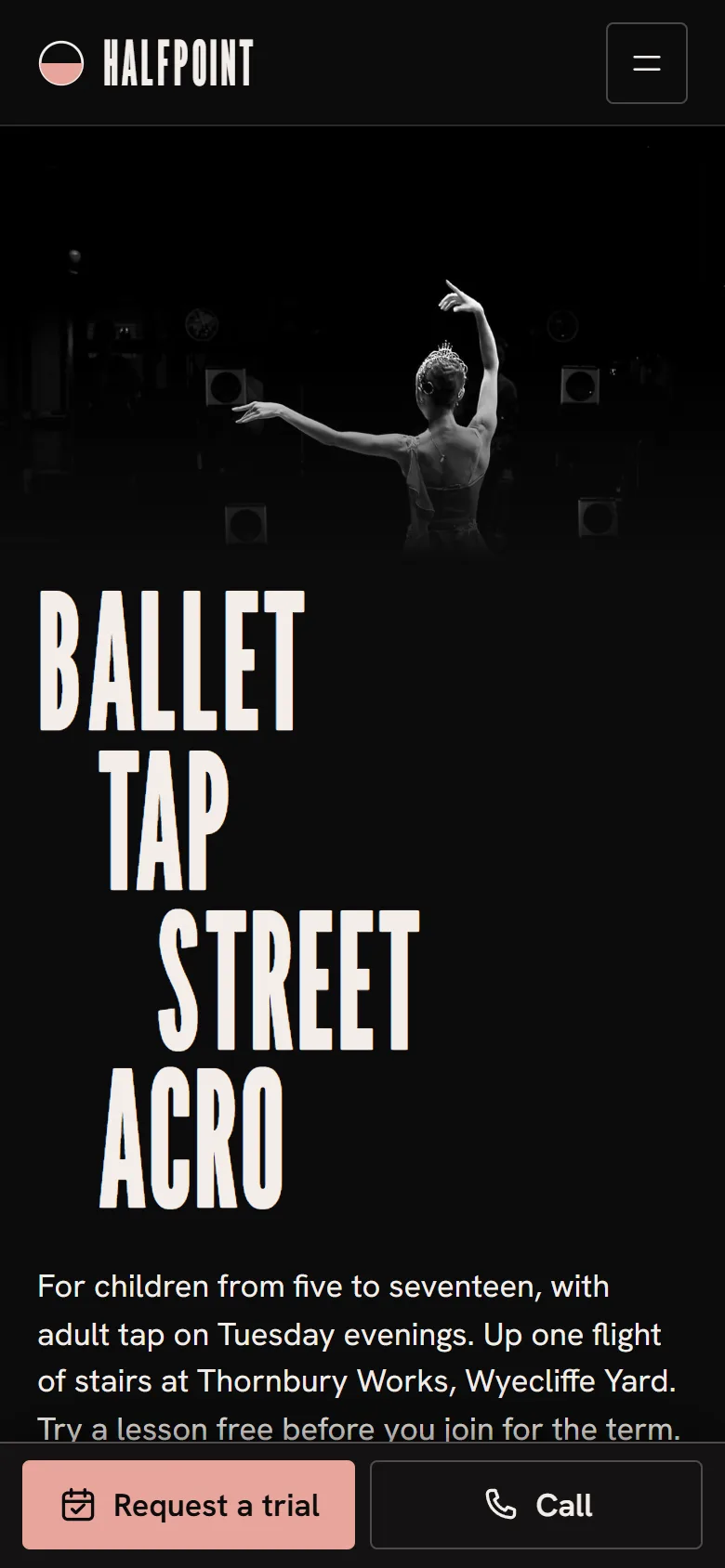
Halfpoint Dance School is a fictional business. We designed and built its website as a demo of how we build for dance schools, using illustrative photography.
Open the live demo(opens in a new tab)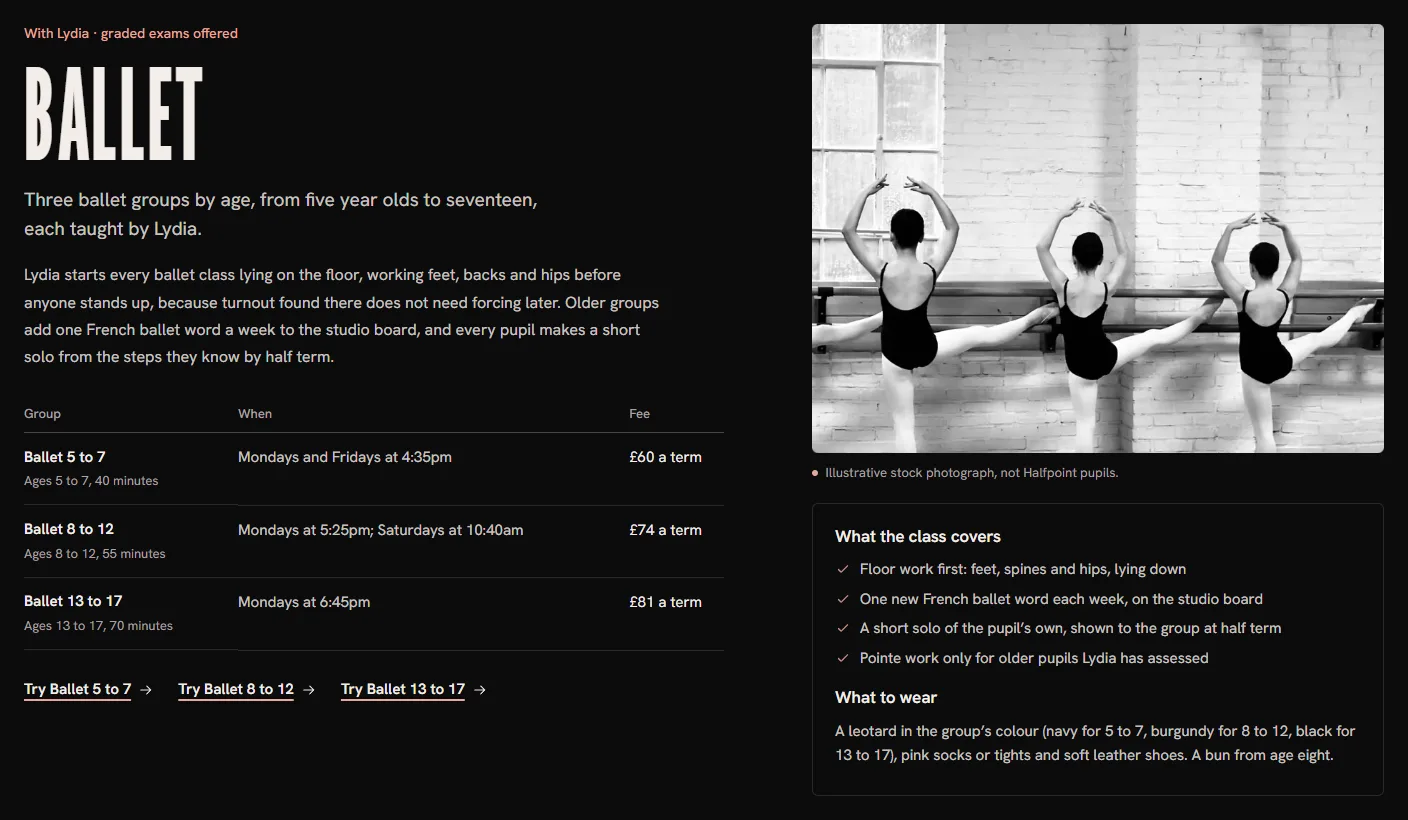
01 / Classes
Every style split into its age groups
Ballet, tap, street and acro each have their own section, with children's groups by age from five to seventeen and an adult tap class in the evening. Every style shows its age groups and teacher, what a class covers and what to wear, and each group carries its own link into a trial request.
Ages on every group
02 / Week view
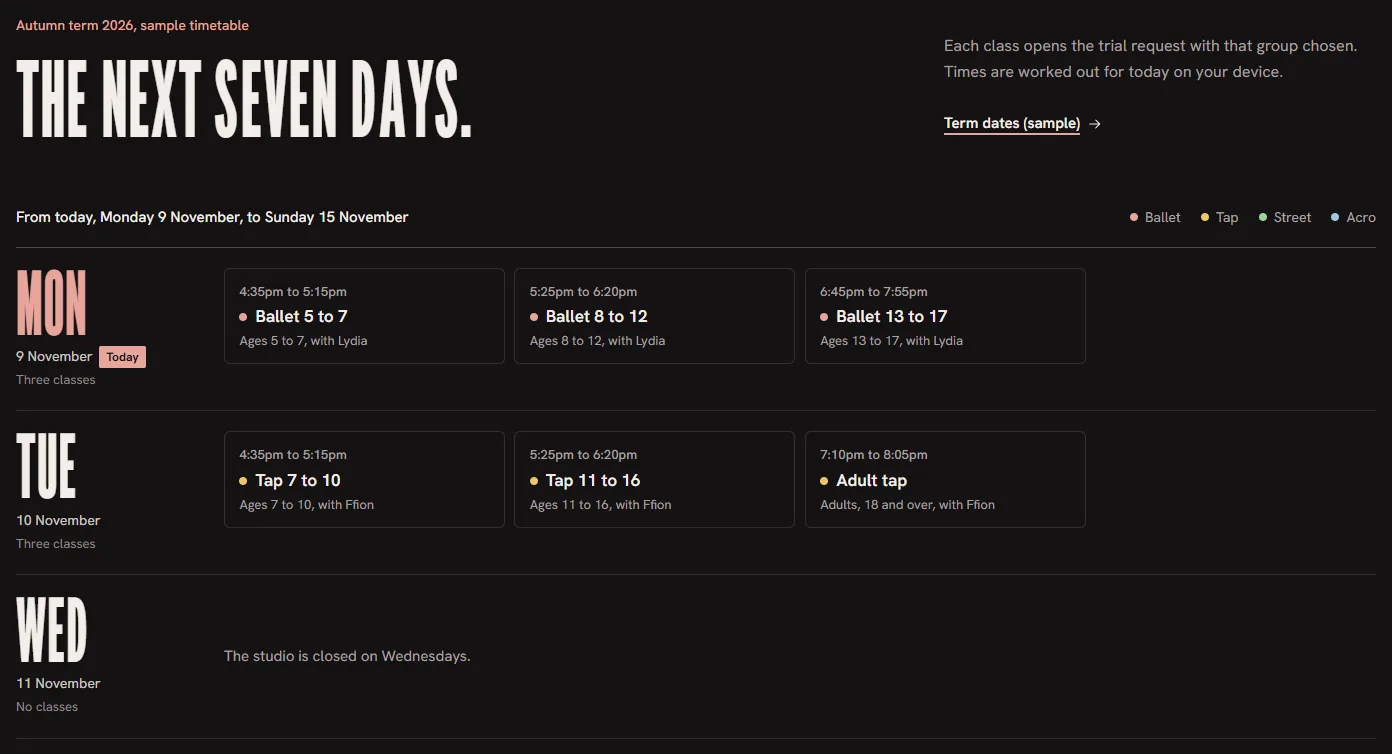
The coming seven days, counted from today
The timetable works out the next seven days on the visitor's own device and marks the school's breaks and bank holidays. A parent sees what runs in the coming week, and any class in it opens the trial request with that group picked.
Starts from today
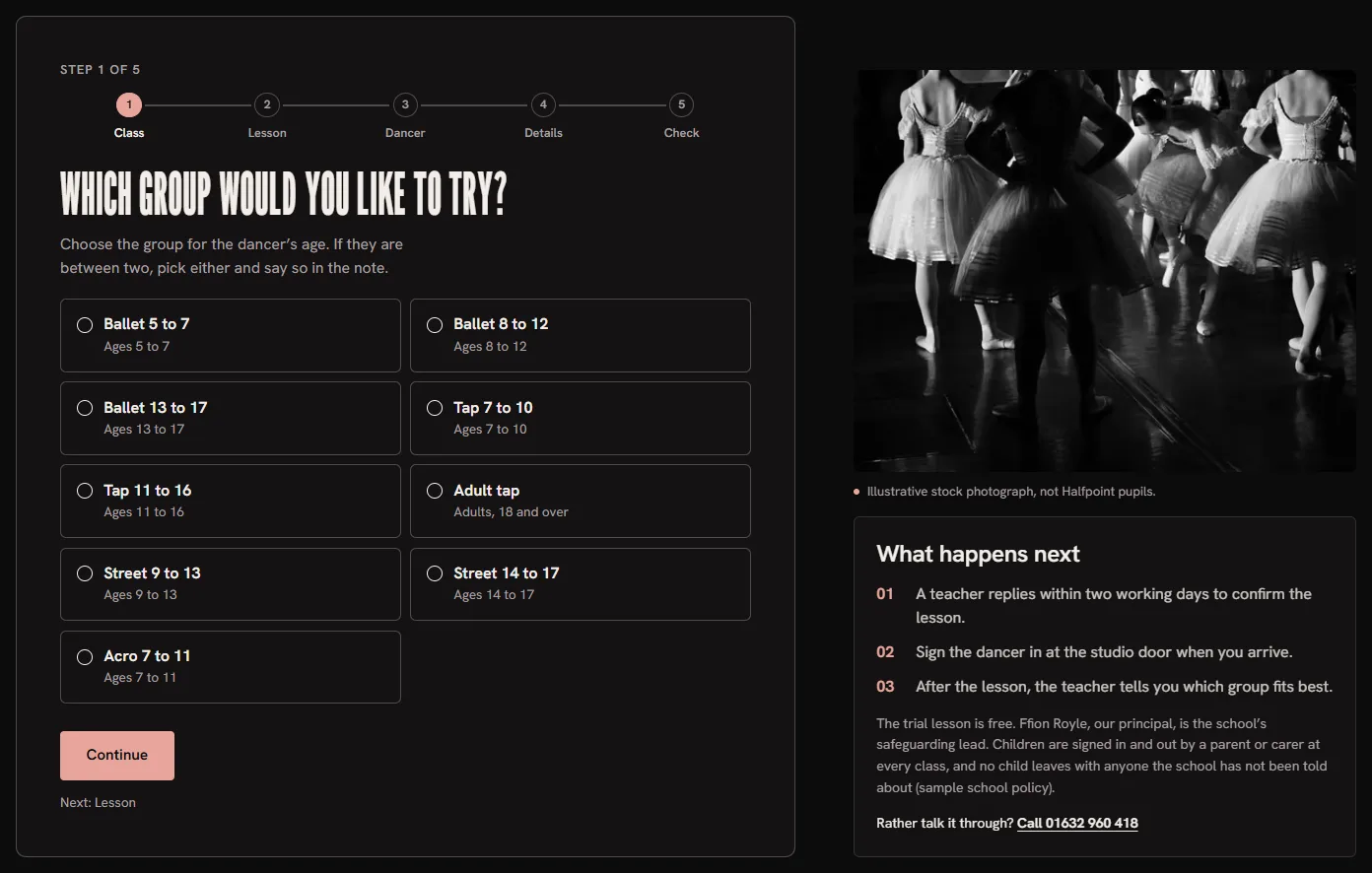
03 / Trial lesson
Five short steps, then a reply from the school
The request asks for the group, a lesson from the next fortnight, how much the dancer has danced before and one way to reply, then reads it back. The group's teacher writes back to say whether there is room. Teacher profiles show who takes each group for the year, and Find us covers parking, the stairs and where parents wait.
The teacher checks for room
For parents and adult beginners
Dance studio website design for schools with classes, exams and a show.
A trial lesson request that starts from the group
Set each style out by age group and let every group open a request for a trial lesson with that group already filled in. Online term fee payments, or a link to the class management system you already use, get looked at and costed as part of the quote.
Show licences sorted before tickets go on sale
In England, Wales and Scotland a child taking part in a ticketed show may need a licence from the council. The Department for Education's advice for England says a dance school attended only for dance training does not count as a school for the exemption, so the show page says which route you use.
Who is backstage with the children
England's 2014 Regulations let one approved chaperone look after up to twelve licensed children at a time. Scotland's limit is ten, and Wales adds child protection training. Tell families who they are, how many children each looks after and how children are handed back after the show.
Exam boards written the board's way
Ofqual lists the ISTD, the RAD, the IDTA and other dance boards as recognised awarding organisations, and each keeps its own register of teachers. Name the board each teacher is registered with and point parents to that board's own teacher search.
Term fees with the stopping rule beside them
The CMA's unfair terms guidance (CMA37) treats making a large advance payment non-refundable whatever happens as more likely to be unfair. Put the notice to stop, what happens to the rest of the term's fee and any allowance for illness next to the price.
Exam results you can show your workings for
A pass rate or a count of distinctions is an objective claim, and the CAP Code needs the evidence held before it goes on the website. Say which exams and which session it covers, and keep the board's results sheets to hand.
Children's classes and adult beginners
Ballet after school. Tap after work.
Dance studio website design for the parent choosing a first class on a phone, and the adult who has not danced since school.
Searches from parents
Kids dance classes near me averages about 6,600 searches a month across the UK, rising to 9,900 in January 2026, and ballet classes near me about 5,400. A class list sorted by age answers the first thing those searches are asking.
Searches from adults
Adult dance classes near me averages about 12,100 searches a month, and ballet classes for adults near me about 2,900. Giving adult groups their own heading and evening times shows those visitors there is a class for them.
Want ongoing support with Google Maps and local rankings?
Explore local SEO →Available separately from your website build.
Example local searches
- Kids dance classes near me
- Ballet classes near me
- Adult dance classes near me
Search counts come from DataForSEO's Google Ads data for the UK, averaged from October 2025 to September 2026 and taken on 6 November 2026.
Clear prices. Clear scope.
Fixed price. Agreed scope. No surprises.
Starter
From£295
One page for a teacher with a handful of classes.
- Classes, ages, reviews and how to reach you on one page
- Trial lesson requests emailed to you and kept
- The site, the domain and every word are yours
Essentials
From£595
Up to five pages for a school teaching several styles.
- Home, classes, teachers, reviews and find us
- Parents can call the studio from any screen
- Google reviews from families shown on the site
- Most popular
Business
From£995
A page for each style, and room for the show.
- Everything in Essentials
- A page for ballet, tap, street or any style you teach
- Galleries of classes and the summer show
- Hosting and care for the first twelve months
- All prices include VAT
- Hosting £15 a month, optional care £25 a month
- SEO plans from £100 a month
Business includes hosting and care for the first year. Or split any package into 12 interest-free monthly payments.
Prices last updated 24 September 2026. See full pricing and what each package includes
Your pages, features, price and timescale, agreed in writing before you pay.
How it works
From first chat to a website that works.
- 01
Brief
Tell us your styles and age groups, who teaches each group, your term dates and fees, your rules for stopping and missed weeks, which exam board your teachers are registered with, and how the show is licensed. We turn that into a written scope with one price that does not move. Online payment or enrolment, if you want it, is costed before you get the quote.
- 02
Build
The class pages, the week view, teacher profiles, the fees and term dates, the trial lesson request and the show page, written with you. You approve every age range, every fee and every line about exams and the show before it goes live.
- 03
Launch
We send a test trial request from each age group, check every class time and fee against the list you gave us and read the fees page on a small phone, and only then switch the site on, on a domain registered to you.
Your questions, answered
Questions dance school principals put to us.
Need a straight answer? Speak to us.
0161 399 4054What will my fixed quote include?
Your pages, the features on them, the final price and the timescale, in writing before you pay a deposit. Hosting, care and any ongoing SEO are listed separately, so you can see what is one-off and what is monthly. On the Business package the first year of hosting and care is included.
Do the children in our show need a performance licence?
Often, once the show sells tickets. In England, Wales and Scotland, the Children and Young Persons Act 1963 requires a licence from the council for any child below school leaving age, babies included, to take part in a performance with a charge for admission or otherwise, or in premises licensed to sell alcohol. No licence is needed if nobody is paid beyond expenses and either the child has not performed on more than three days in the previous six months, or the show is put on by a school or under a body of persons approval (BOPA) from the council where it takes place. The Department for Education's advice for England says a dance school a child attends only for dance training is not a school for that exemption, and that the four day rule cannot be used if the child would miss school. In England the limits on hours still apply under the four day rule. Wales and Scotland have their own regulations under the same Act, and Northern Ireland has its own Order. Say on the show page which route the school uses once the council has confirmed it.
Who can look after the children backstage at our show?
For a licensed child in England, a chaperone approved by the council that issued the licence, unless the child is with a parent or the teacher who ordinarily provides their education. One chaperone may look after up to twelve children at a time, or three if they are the child's private teacher. Wales sets the same numbers and adds that the chaperone must have done child protection training; in Scotland the limit is ten. Northern Ireland has its own regulations, which call the role a matron. Under a BOPA, the Department for Education's advice says the law does not require a council-approved chaperone, though the approval comes with the council's own criteria and conditions. On the website, tell families who will be backstage, how many children each adult has, and how children are handed back at the end.
What are ISTD, RAD and IDTA, and how do parents check a teacher?
They are dance exam boards. Ofqual, which regulates qualifications in England, lists the Imperial Society of Teachers of Dancing (ISTD), the Royal Academy of Dance (RAD) and the International Dance Teachers Association (IDTA) as recognised awarding organisations, along with others such as the NATD and the British Ballet Organization, and CCEA Regulation recognises several of them in Northern Ireland. Each sets its own syllabus and graded exams and keeps its own register of teachers. The RAD says only its Registered Teachers can enter students for RAD exams, and that its map shows only teachers who chose to be listed, with a full register for the rest; the ISTD runs a teacher search of its own. So on the teachers page, name the board each teacher is registered with, in the board's words, and link that board's search so parents can check. A school whose teachers are not registered with a board should say nothing that suggests they are.
Can our website show exam results and UCAS points?
Yes, if every figure can be backed up. The CAP Code, which the ASA applies across the UK, your own website included, needs documentary evidence for an objective claim such as a pass rate or a count of distinctions before it is published, so keep the results sheets for the session you quote and say which exams and which year it covers. Its section on children adds that marketing aimed at them must not exaggerate what an ordinary child can achieve, so a results line describes what pupils did, not what a new pupil will do. UCAS points belong to the board's qualification rather than to the school: the ISTD says its Grade 6 and Intermediate exams sit at Level 3 of the Regulated Qualifications Framework and carry UCAS Tariff points, with Grade 6 worth 8, 10 or 14 at pass, merit or distinction. Quote the board's own figures and link the page they come from.
Can we keep a whole term's fees if a pupil stops halfway through?
It depends on what your terms say and how they work out. Under the Consumer Rights Act 2015, which applies across the UK, a term that lets you keep money paid when a family decides not to carry on, or makes them pay a disproportionately high sum for classes not given, may be regarded as unfair, and an unfair term does not bind them. The CMA's guidance says making a substantial prepayment entirely non-refundable regardless of the circumstances is more likely to be unfair, and that a charge for leaving early should reflect what you save and whether you can fill the place, for instance by offering it to someone else. A stated sum that is a genuine estimate of your loss, set out clearly and where families will see it, is more likely to be fair. Put the notice to stop, what happens to the rest of the fee and any allowance for illness on the fees page, next to the price.
Do we need a music licence for exam classes and the show video?
Usually for classes, though exam work may cost less. PPL PRS says a dance teacher holding classes in venues such as church halls or community centres needs TheMusicLicence; its example, correct as of July 2026, is £96.24 a year, or 64p a class plus VAT, for three classes a week of 20 dancers for 50 weeks in a village hall. PRS for Music, one of the two bodies behind it, makes no charge of its own for music played in a lesson or exam leading to a qualification at RQF Level 1 or above, where the school is not an educational establishment under copyright law; that policy covers the PRS share only. For a recording of the show given or sold to families on DVD or another physical copy, PRS for Music's Limited Manufacture licence, as its page described it in April 2026, covers both the songs and the recordings for up to 1,000 copies, with a limit of 250 for PPL's recordings. These are the two bodies' own policies, and they cover the UK. A studio's licence for its own premises is covered on our page for class studios.
Let's build your next step
Want parents to find the right class first time?
Send us your styles and age groups, your teachers, your term dates and fees, and how you run the show. The fixed price comes back in writing, page by page.