Tattoo studio website design
Tattoo studio website design that turns an idea into a consultation
Many tattoos start as a rough idea, a reference or a phrase, and a client wants to know who in the studio draws that kind of work before asking anything. In the UK, tattoo shops near me draws about 110,000 searches a month. Your website shows each style and the artist behind it, explains how custom work is priced, then takes a short request so the conversation about the design starts with the right person.
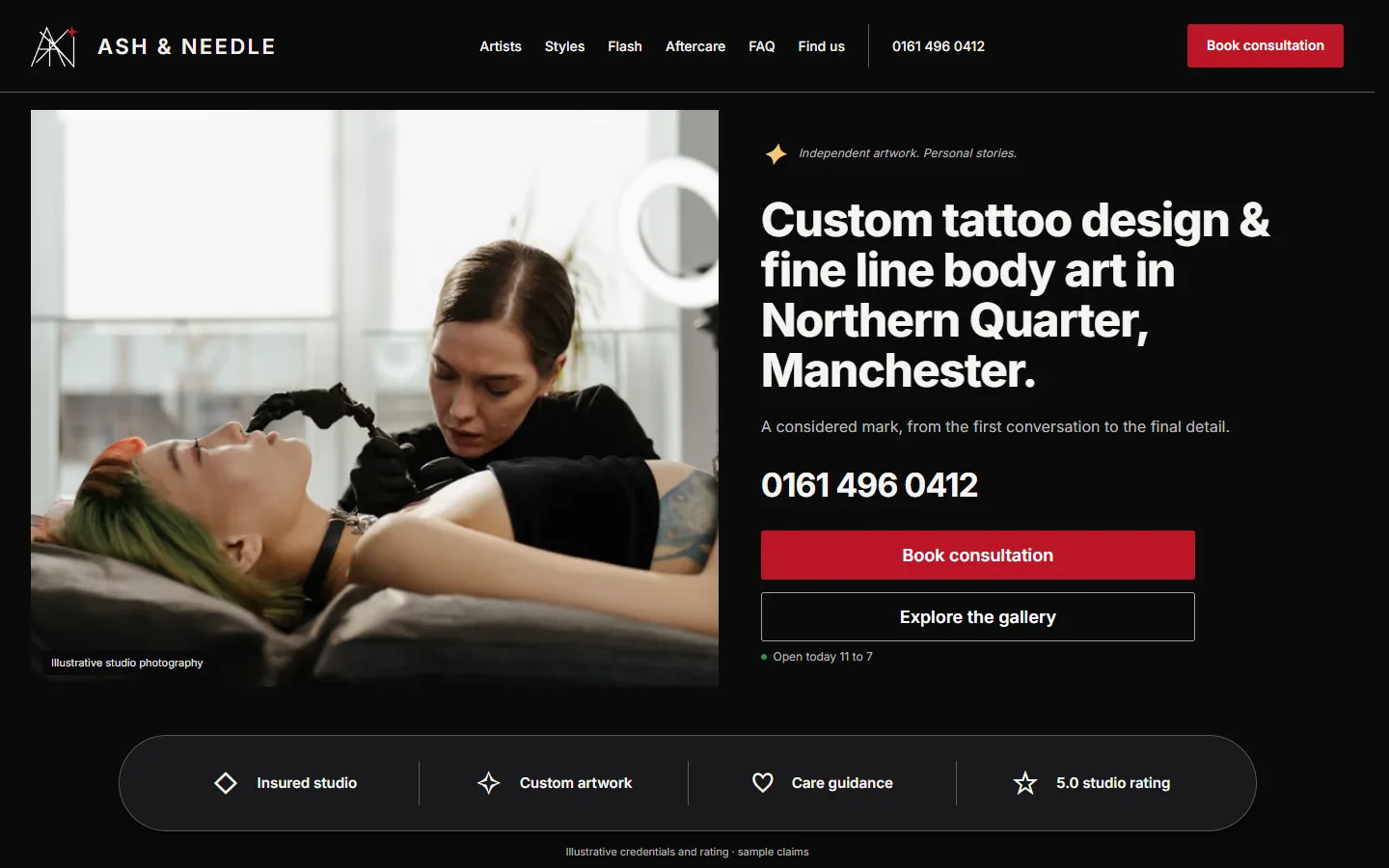
Ash & Needle, a demo we designed and built for tattoo studios. A fictional business, with illustrative photography.
Example site
A custom tattoo studio website for Manchester
- Four styles, each explained
- An idea request, not a booking
- Aftercare pointed to the artist
Demo website
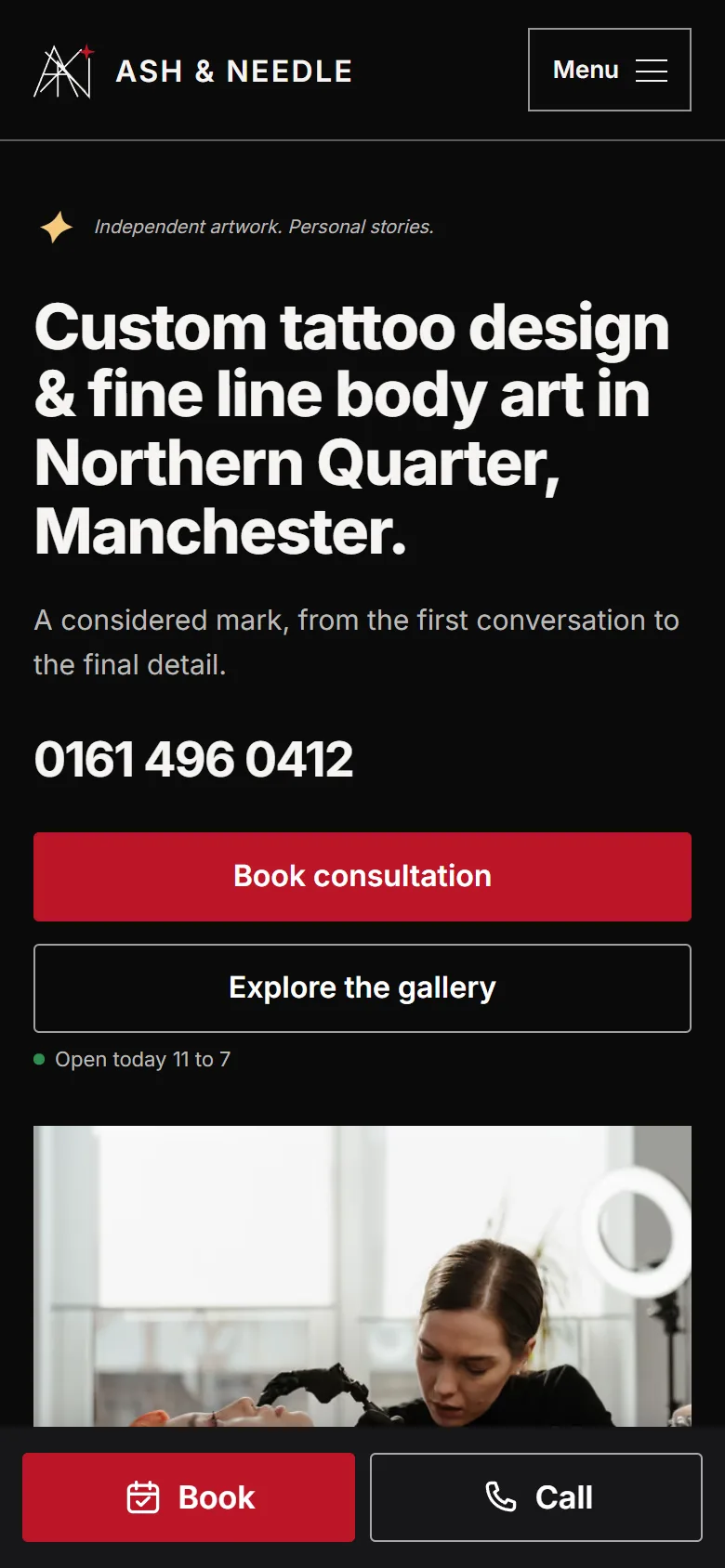
Ash & Needle is a fictional business. We designed and built its website as a demo of how we build for tattoo studios, using illustrative photography.
Open the live demo(opens in a new tab)01 / Styles
Pick the look, then the hand
Fine line, black and grey realism, traditional and script lettering each get a short explanation of what suits them and what to bring. Every artist profile names a focus and links straight into the request, and a flash section shows ready-drawn studies as a starting point, with the price agreed for the chosen design and size.
Style first, artist second
02 / Request
Four steps to start the conversation
The request asks for a style, an artist or help choosing, a name and a phone number or email, then shows everything back for a check. It says plainly that sending it is not an appointment and that the design is talked through before any session, and the note box asks clients not to include anything medical.
Not an appointment
03 / Care
Aftercare that sends clients back to their artist
The aftercare section tells clients to go through the artist's written instructions before they leave, to ask what dressing was used and how to get in touch with questions, and says the website does not replace advice from the artist or a healthcare professional. The gallery labels every photo as stock, not the artists' work.
Written instructions first
Before the consultation
What a client wants to know before sending an idea.
Styles before artists
Explain each style in a line or two and show which artist leans that way. A client who knows the look but not the names finds the right person in one tap.
A rate card for work that is quoted
Custom pieces rarely have a fixed price, so give the parts you can fix: a minimum charge, an hourly rate, a full day, and how flash is priced. Say the design is quoted after a conversation. A deposit or booking system link is checked and priced before the quote.
Eighteen and over, before the form
Tattooing anyone under 18 is an offence across the UK, under the 1969 Act in Great Britain and a 1979 Order in Northern Ireland, and a parent's consent does not change that. Say it above the request, with the ID you accept.
Aftercare in writing, with a contact
In Wales, the licence conditions require aftercare advice spoken and written, in plain language, with the artist's contact details. Elsewhere it is good practice. Your website can say that written instructions come with every session, and who to ask afterwards.
A portfolio that names the hand
Credit each piece to the artist who did it. A drawing or photo belongs first to whoever made it unless they are employed, so agree in writing what happens to a self-employed artist's work on your site when they move on.
Registration, kept on the wall
English councils that register tattooists, London boroughs, Wales, Scotland and Northern Ireland each run their own scheme. In England the registration certificate, and in Wales the licence, must be on display at the studio. Nothing requires it online, but naming your council lets a client check.
Found by people with an idea
The right artist. Before the first sketch.
Tattoo studio website design for people who have the idea and are now looking for the artist.
Searching for a studio nearby
About 110,000 searches a month look for tattoo shops near me, 27,100 for a tattoo near me and 6,600 for a tattoo artist near me. Styles and profiles answer what they are really comparing.
Asking before they commit
Tattoo prices draws about 2,900 searches a month and can you get a tattoo at 16 about 1,300. A rate card and a plain age line answer both before anyone fills in the form.
Want ongoing support with Google Maps and local rankings?
Explore local SEO →Available separately from your website build.
Example local searches
- Tattoo near me
- Tattoo artist near me
- Tattoo studio near me
Search figures: DataForSEO (Google Ads, UK), 12-month averages, October 2025 to September 2026; read 4 November 2026.
Clear prices. Clear scope.
Fixed price. Agreed scope. No surprises.
Starter
From£295
One page for an artist working alone.
- Your style, rates and contact on one page
- An idea request that arrives in your inbox
- Clients tap to call from any phone
Essentials
From£595
Up to five pages for a studio with a few artists.
- Home, styles, artists, reviews and find us
- Your Google reviews beside the work
- An idea request that arrives in your inbox
- Most popular
Business
From£995
A page per style and a portfolio per artist.
- Everything in Essentials
- A page for each style you want more of
- Portfolios of your artists' own work
- The first year's hosting and care
- All prices include VAT
- Hosting £15 a month, optional care £25 a month
- SEO plans from £100 a month
Business includes hosting and care for the first year. Or split any package into 12 interest-free monthly payments.
Prices last updated 24 September 2026. See full pricing and what each package includes
Your pages, features, price and timescale, agreed in writing before you pay.
How it works
From first chat to a website that works.
- 01
Brief
Tell us who works in the studio, the styles each takes on, how you price custom pieces and flash, and how clients reach you now. If deposits or bookings already run through a system, whether the site can connect to it is checked and priced before the quote.
- 02
Build
We draft the style pages, artist profiles, idea request, aftercare page and photo credits together, and nothing about age, aftercare or session prices goes live until you sign it off.
- 03
Launch
Before launch we try the request with each artist picked, match every photo to the artist who did it, and check the age line and rate card on a small screen. The site goes live on a domain in your name.
Your questions, answered
Questions tattoo studios ask us.
Need a straight answer? Speak to us.
0161 399 4054What will my fixed quote include?
Your pages, the features on them, the final price and the timescale, in writing before you pay a deposit. Hosting, care and any ongoing SEO are listed separately, so you can see what is one-off and what is monthly. On the Business package the first year of hosting and care is included.
Can a 16-year-old get a tattoo with a parent's consent?
No. In England, Wales and Scotland, the Tattooing of Minors Act 1969 makes it an offence to tattoo anyone under 18, and its only exception is a tattoo done for medical reasons by a doctor or someone working under one; a parent's consent is not an exception. Northern Ireland sets the same age in its own 1979 Order. In Scotland, a licensed studio's waiting area must display a notice that tattooing will not be carried out on anyone under 18, and in Wales the consultation form records that the client's age was checked. The Act's defence is reasonable cause to believe the person was 18 or over, which is why studios ask for ID. Put 18 and over, and the ID you accept, above the request form. The Ash & Needle demo does not have this line; a real studio's site should.
Can my website mention numbing cream?
Only carefully, and in Wales hardly at all. Across the UK, the CAP Code needs evidence for any claim a reader would take as fact before it is published, so pain free or painless is hard to stand behind. In Wales, the special procedure licence conditions say the tattooist must not supply or apply a topical anaesthetic before, during or after the work, and must not go ahead if a client has used one that the MHRA has not approved and authorised. A Welsh studio's site should not offer numbing as a service and can ask clients to mention anything they plan to use. Elsewhere, say what your studio allows and why. The demo makes no claim about pain.
What aftercare should the website give?
Enough to send clients back to the right person. In Wales it is a licence condition: aftercare advice must be given out loud and in writing, in plain language, with the contact details of the artist who did the work. We found no national rule setting it in England, Scotland or Northern Ireland, but the same approach works there. The website can say that written instructions come with every session, who to contact with questions, and when to get advice from a healthcare professional. Leave out a healing timeline you could not prove. The demo's aftercare section does this: it points clients to their artist's written instructions and says the site does not replace advice from the artist or a healthcare professional.
Can I tattoo from home or at a convention?
It depends where you are, so check with your council first. In the parts of England where a council registers tattooists under the 1982 Act, both you and your premises are registered, and a registered tattooist may sometimes visit people at their request. In London, the borough licenses premises for tattooing as a special treatment. In Wales, each tattooist needs a personal licence and the work must happen in approved premises or an approved vehicle; an event organiser counts as the business, and approval can be granted for up to seven days. Scotland and Northern Ireland run their own licensing and registration. Whatever applies, the website should say where the work happens.
How do I show prices for custom tattoos?
Give the fixed parts and explain the rest. Tattoo prices is searched about 2,900 times a month in the UK and how much is a tattoo about 880, so clients look before they ask. The demo's rate card lists a minimum charge, an hourly rate and a full-day sitting, prices flash per design, and says each custom design is quoted after a conversation about its size, detail and placement. Keep the rates on the site and the ones you quote in the studio the same.
How much does a tattoo studio website cost?
The price follows the number of artists and pages. A single artist with one style suits Starter, from £295. Five pages for the styles, the artists, your story, reviews and directions is Essentials, from £595. A page for each style and a portfolio for every artist is Business, from £995. Each price includes VAT and is agreed in writing first, and the pricing page sets the three side by side.
Let's build your next step
Want ideas arriving with the right artist's name on them?
Tell us your artists, the styles each takes on and how you price custom work. We reply with a fixed price and the list of pages we would build.