Personal trainer website design
Personal trainer website design that sets out each session and keeps client results within the rules
Someone choosing a personal trainer wants four answers before sending a message: where the sessions happen, what an hour costs, who the trainer is and whether a complete beginner will cope. Google UK sees about 18,100 searches a month for personal trainer near me. Personal trainer website design puts those answers on a phone: every way of training on its own page with its length and fee, a short request for a first conversation, the qualification as the certificate words it, and client stories that stay inside the advertising rules on weight. Fitness trainer website design for someone who only visits homes follows the same plan on fewer pages.
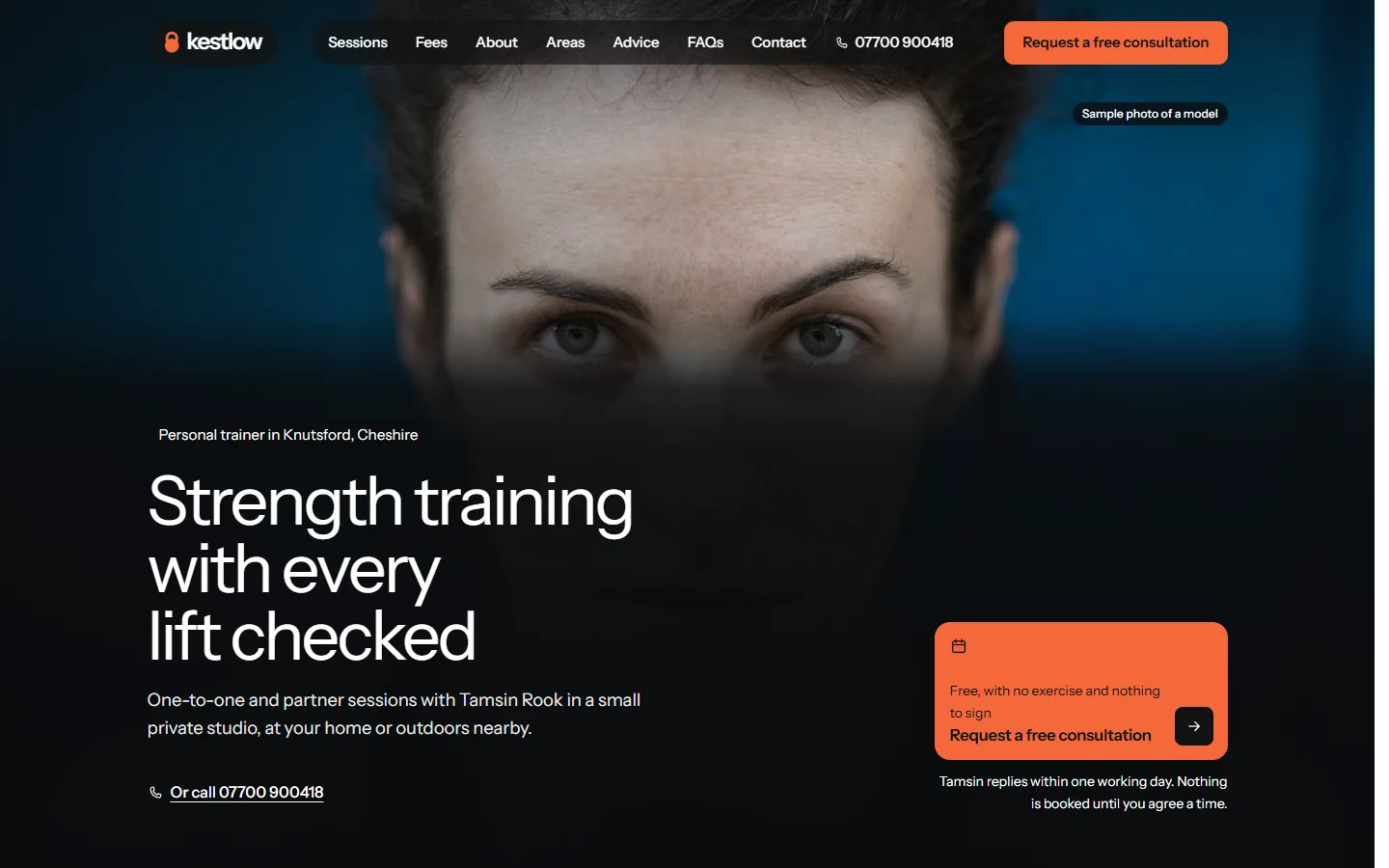
Kestlow Strength, a demo we designed and built for personal trainers. A fictional business, with illustrative photography.
Example site
A one-trainer strength practice in Knutsford, Cheshire
- Four session pages
- Consultation request in four steps
- Home visits within five miles
Demo website
Kestlow Strength is a fictional business. We designed and built its website as a demo of how we build for personal trainers, using illustrative photography.
Open the live demo(opens in a new tab)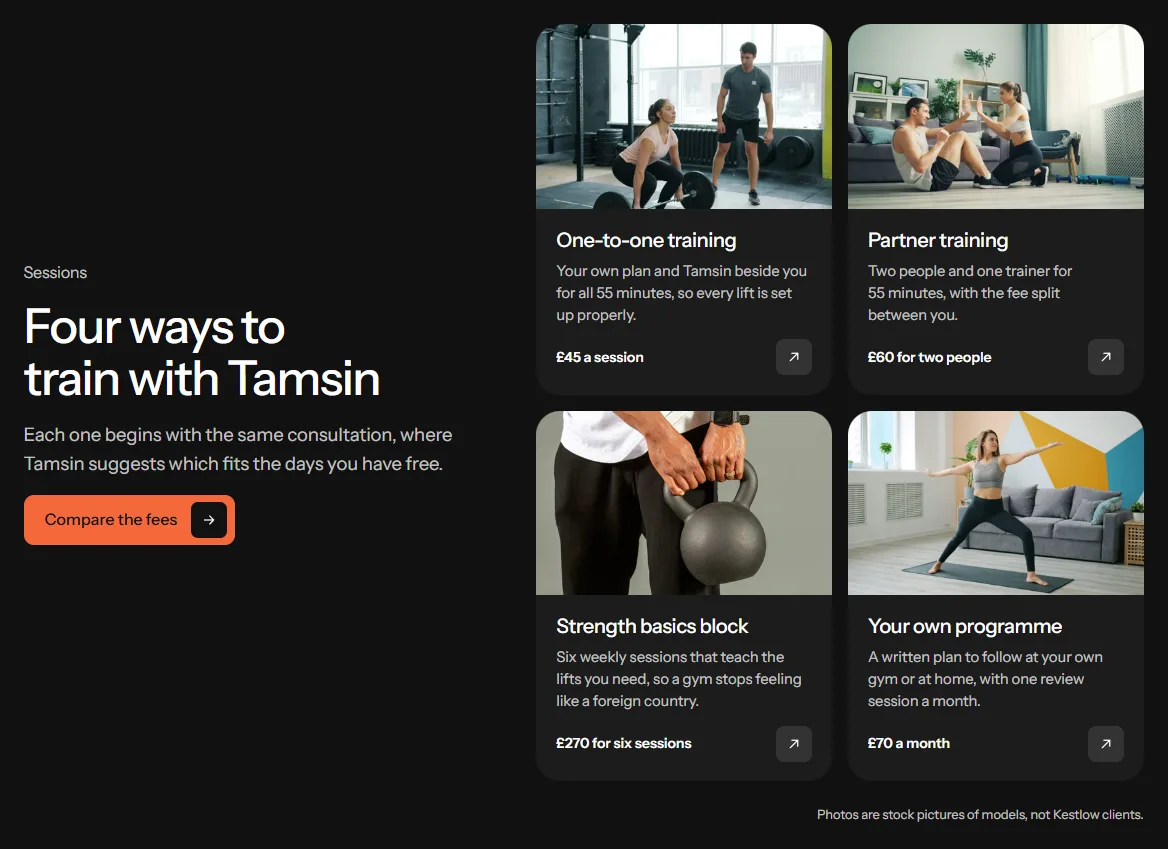
01 / Sessions
Four ways to train, every one 55 minutes long
One to one, partner training, a six-week block that teaches the main lifts, and a written programme with a monthly review each get a page saying who they suit, what happens in a session and what follows. The length is the same on every page, and the fees are marked as samples with the date they were checked.
A page for every way to train
02 / Request
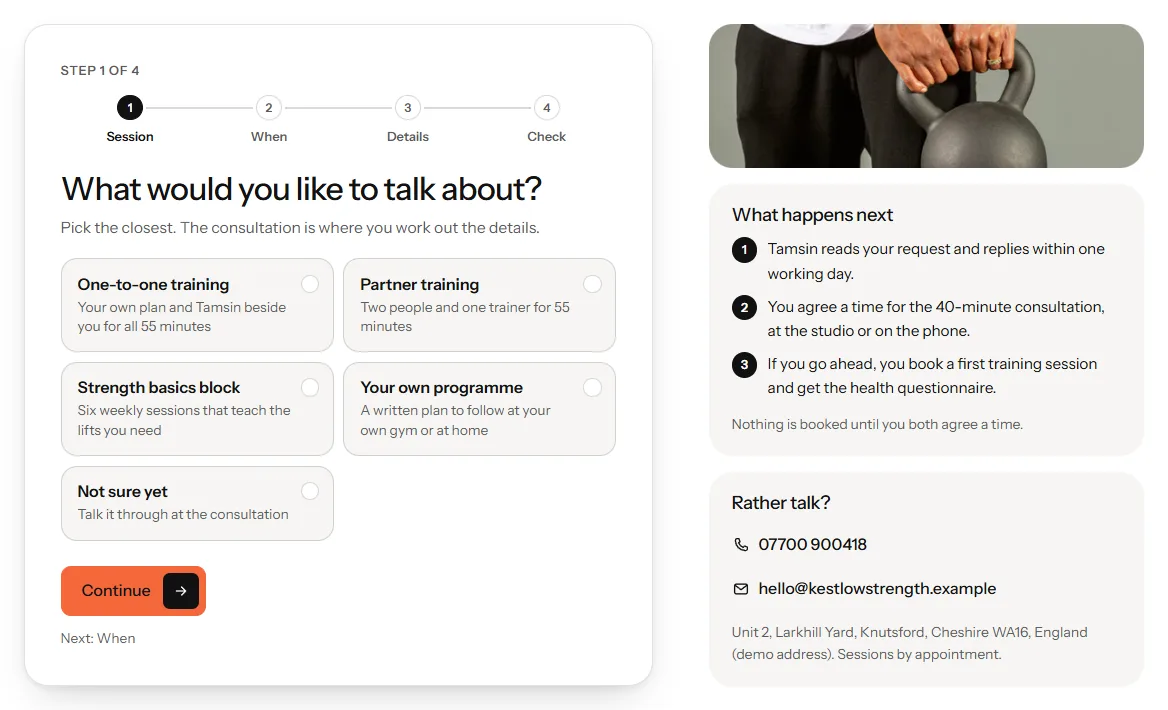
A first conversation asked for, not a session booked
The request opens on what the visitor wants to talk about, then where they could train (the studio, at home, outdoors or undecided) and which part of the day suits, then a name with one way to reply, then a summary to check. Its note field asks for no health details, because those wait for the questionnaire before a first session.
Health details kept out of the form
03 / Advice and Find the studio
Dated advice with its sources, and a real street map
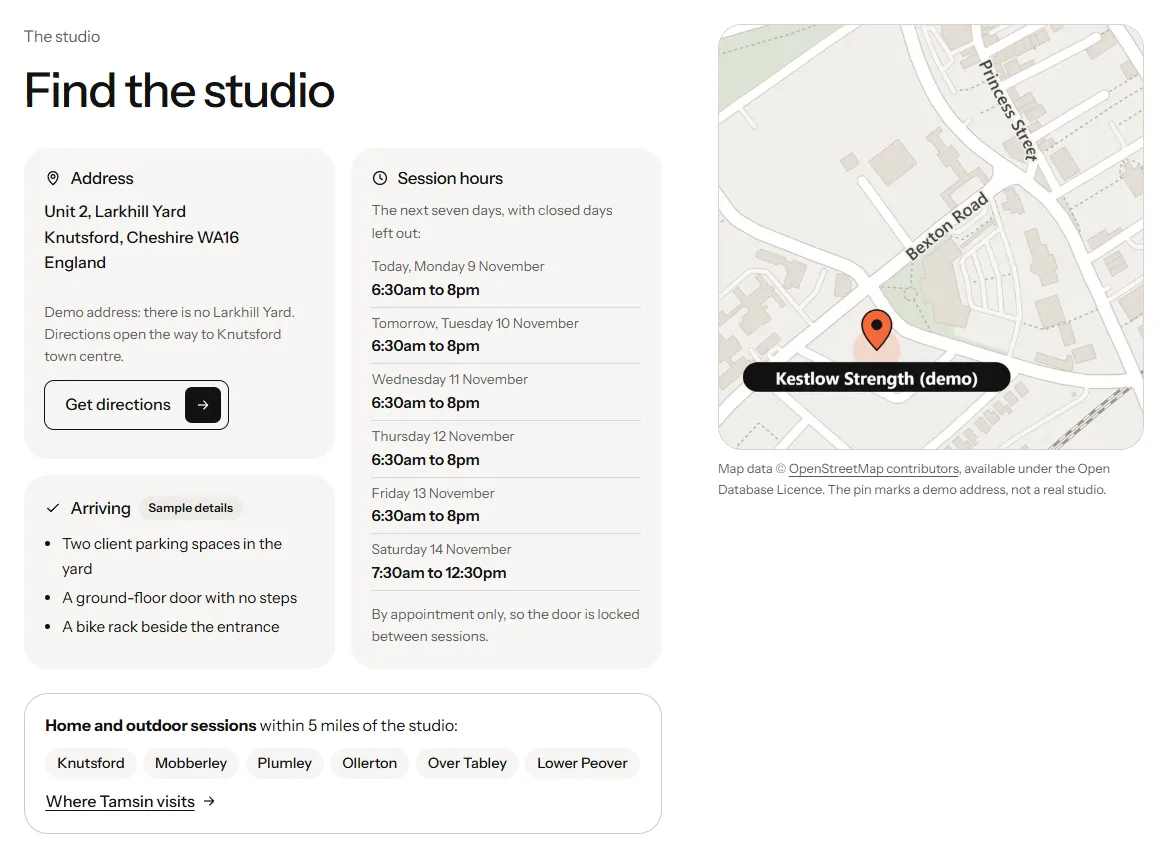
Two short articles, one on the health questionnaire and one on choosing a trainer that sets out the CAP weight rules, each end with their sources and the date they were checked. Find the studio gives the hours with am and pm, the coming seven days, arrival notes, Get directions and a street map of central Knutsford from OpenStreetMap, its pin labelled as a demo address.
Hours shown for the next seven days
For beginners, returners and people who already lift
Personal trainer website design for one trainer and a full diary.
Client stories that give the weeks as well as the pounds
The UK CAP Code's rule 13.10 lets a story say one client lost an exact amount, if it states over what period, fits good medical and nutritional practice and does not rest on an unrepresentative case. For people who are normally overweight, CAP says more than 2 lbs a week is unlikely to pass.
Transformation photos of your own clients only
The ASA treats before and after photos as testimonials: genuine, unaltered, with signed and dated proof and the client's permission. In 2012 it ruled against a boot camp whose photos came from its franchisor yet sat beside claims about its own participants.
Weight loss offered, obesity left to supervised care
Under the UK CAP Code's rule 13.2, a treatment for obesity must not be advertised to the public unless it is used under suitably qualified supervision, or the programme meets every standard in 13.2.1. In 2014, before 13.2.1 existed, the ASA found a personal training qualification was not, on its own, a suitable qualification for that.
Food advice that stays inside a trainer's scope
CIMSPA's description of the role includes everyday nutrition advice and knowing when to refer to a registered dietitian. Dietitian is a title the HCPC protects across the UK, and any diet plan a site advertises has to be nutritionally well balanced (the UK CAP Code's rule 13.5).
Qualification lines a client can look up
Ofqual's register for England lists regulated Level 3 personal trainer qualifications by title. Copy the award title and the awarding organisation from the certificate, and drop any REPs line: its members were invited to move to CIMSPA by July 2021.
Screening, notes and cover, each called what it is
A health questionnaire is good practice rather than a legal duty. Session notes, weights and measurements may count as health data under the UK GDPR. Insurance is your choice unless you employ staff, when employers' liability is compulsory in Great Britain.
One to one, at home and outdoors
Every lift watched, at the studio or in a living room.
Personal trainer web design for the client comparing three trainers on a phone, who wants the price, the place and some sign that a first timer will be looked after.
Searches for a trainer nearby
Personal trainer near me averages about 18,100 searches a month in the UK and reached 33,100 in September 2026; personal training near me adds about 1,300. A site that names where you train and when you have space is what those searches are looking for.
Searches about cost and place
How much is a personal trainer averages about 1,600 searches a month, strength training near me about 720 and personal trainer at home about 260. Session fees, session length and how far you travel belong on the page, not in a reply.
Want ongoing support with Google Maps and local rankings?
Explore local SEO →Available separately from your website build.
Example local searches
- Personal training near me
- How much is a personal trainer
- Personal trainer at home
Search figures are Google Ads UK averages for October 2025 to September 2026, taken from DataForSEO and read on 6 November 2026.
Clear prices. Clear scope.
Fixed price. Agreed scope. No surprises.
Starter
From£295
One page for a trainer with a few regular clients.
- Your sessions, reviews and contact details together on one page
- Each consultation request sent to your inbox and stored
- You keep the site, the domain and every word on it
Essentials
From£595
Five pages for a trainer with a busy diary.
- Home, sessions, about, client reviews and contact
- Tap to ring you from any page, between sets or on the bus
- Google reviews from your clients, pulled onto the site
- Most popular
Business
From£995
A page for each way you train, and for home visits.
- Everything in Essentials
- A page each for one to one, partner training or a block of sessions
- Client stories and photos, with permission on file
- Hosting and upkeep paid for through year one
- All prices include VAT
- Hosting £15 a month, optional care £25 a month
- SEO plans from £100 a month
Business includes hosting and care for the first year. Or split any package into 12 interest-free monthly payments.
Prices last updated 24 September 2026. See full pricing and what each package includes
Your pages, features, price and timescale, agreed in writing before you pay.
How it works
From first chat to a website that works.
- 01
Brief
Tell us how you train people and where, how long a session runs, your fees and packs, the miles you will travel, each qualification exactly as its certificate prints it, and which client stories and photos you hold signed permission for. We agree the pages with you and put one figure on them. If clients should book or pay online, or you want a link to the app you write programmes in, we find out what that involves first so the figure already covers it.
- 02
Build
The session pages, fees, your profile and qualifications, the consultation request, the home visit area and the Find us details, which we write with you in plain words. Before anyone else sees them, you sign off each client story against its permission, each line about weight or food and each fee.
- 03
Launch
A test request goes through for each way you train, then we compare every fee and session length with your list and read the client stories on a small phone screen. Once you are happy with all of it, the site is published on an address that stays in your name.
Your questions, answered
Questions personal trainers bring to us.
Need a straight answer? Speak to us.
0161 399 4054What will my fixed quote include?
Your pages, the features on them, the final price and the timescale, in writing before you pay a deposit. Hosting, care and any ongoing SEO are listed separately, so you can see what is one-off and what is monthly. On the Business package the first year of hosting and care is included.
Can a client's story on our website say how much weight they lost?
Yes, if it is about that one client and meets CAP's conditions. Rule 13.10 of the CAP Code, which covers UK advertising including a trainer's own website, says a claim that someone lost an exact amount must be compatible with good medical and nutritional practice, must state the period involved and must not be based on unrepresentative experiences. For people who are normally overweight, it says losing more than 2 lbs a week is unlikely to be compatible. CAP's advice on weight control testimonials, updated in April 2026, gives 'I lost 8lbs in six weeks on the recommended diet plan!' as an acceptable claim, provided the programme's effect is backed by evidence and you hold signed, dated proof that the story is genuine, with the client's permission to use it. What a story must not do is suggest the next client will lose a set amount in a set time, which rule 13.9 forbids. On the demo, the FAQ that asks for a promised weight loss is answered no, with rule 13.9 cited.
Can we use transformation photos that are not our own clients?
Not in a way that suggests they are. CAP and the ASA (UK) treat before and after photos the same way as testimonials, so the CAP Code's rules 3.47 to 3.50 apply: hold signed and dated proof that the photos are genuine and have not been manipulated, and the permission of the person shown. In 2012 the ASA ruled against a franchised boot camp in Newcastle whose website showed before and after pictures supplied by its franchisor under a licensing agreement, next to claims about its own participants. It found readers would take the people pictured to have trained there, and with no evidence that they had, the ad was misleading. A stock photo of a model can still show what a session looks like, as long as it is labelled and claims no result. The demo labels its photos as stock pictures of models, not clients.
Can our website say we help clients with obesity or type 2 diabetes?
Only with great care. CAP rule 13.2 defines obesity in adults as a BMI over 30 and says a treatment for it must not be advertised to the public unless it is used under suitably qualified supervision. Rule 13.2.1 lets lifestyle weight management programmes refer responsibly to obesity only if they meet all five of its standards, among them evidence of results at 12 months or beyond and input from a registered dietitian and a registered practitioner psychologist, which a trainer working alone is unlikely to have. In 2014, before that exemption existed, the ASA ruled on a London bootcamp whose site showed before and after photos and stories of losing several stone. It found the site implied a treatment for obesity, and that a personal training qualification which included a module on obese clients was not a suitable qualification in itself. CAP's testimonials advice also records a case where the ASA considered implied claims to treat diabetes would discourage essential medical treatment (rule 12.2). Strength work alongside a client's own GP care is a different message.
Can our website offer meal plans or nutrition advice?
Everyday advice, yes; clinical diet plans, no. CIMSPA's own description of the personal trainer role includes nutritional and lifestyle advice, and knowing when to refer a client to a physiotherapist, a registered dietitian or a medical specialist. Dietitian is a protected title: the Health and Care Professions Council, which regulates across the UK, says that to use it a person must be on its register. So a trainer's site should not describe its food advice as a dietitian's. If you do advertise a diet plan, CAP rule 13.5 says you must be able to show it is nutritionally well balanced for the people it is aimed at, and the ASA upheld that rule against the same London bootcamp over its sample meal plan. The demo's FAQ says its trainer talks about everyday eating, writes no meal plans and sends food advice for a medical condition to a registered dietitian or a GP.
Our trainer was REPs registered. What should the website say now?
Take the REPs line down, or put it in the past tense. REPs, the Register of Exercise Professionals, no longer registers trainers: CIMSPA offered its members a transfer into CIMSPA membership with a closing date of July 2021, and the old REPs web address now forwards to UK Coaching's fitness insurance page. The government's Regulated Professions Register, which covers the UK, lists no reserved activity for this work, so the qualification is what a client can check. Write it as the certificate words it, with the awarding organisation. In England, Ofqual's public register lists regulated Level 3 personal trainer qualifications by title, and CIMSPA says an awarding organisation's certificate shows the award title, a qualification number, a certificate number, the date of issue and the Ofqual logo. Use CIMSPA's post-nominals only if you hold that membership. The demo labels its Level 3 line as a sample and names no awarding body. Our page for class studios covers CIMSPA's public directory.
Do we need permission to train clients in a public park?
Often, and it depends on whose park it is. We found no single national rule: each council or landowner sets its own terms. In England, Southwark Council says you must have a licence to use one of its parks for personal training, whether you charge or not, and keeps licensed sessions away from playgrounds and booked pitches. Bournemouth, Christchurch and Poole Council licenses outdoor exercise classes at £100 per weekly session for a year (read on 6 November 2026), and first asks for public liability insurance of at least £5m, a risk assessment, instructor certificates, a first aid qualification and a DBS certificate for work with under 18s. That is the one place we found where insurance is required, and it is the council's condition rather than the law's. So before your website offers outdoor sessions, ask the council about each park you name. A client's own garden is a separate question, settled with the client. The demo's areas page says park sessions run only where the trainer holds any licence or permission the council requires, and labels that as sample practice.
Let's build your next step
Want consultation requests that arrive with the days a client can train?
Send us how and where you train people, your session lengths and fees, the qualifications on your certificates and any client stories you have permission to use. We answer with a single price and the list of pages behind it, and nothing is built until you say yes to both.