Osteopathy website design
Osteopathy website design written within the rules on claims and titles
Osteopathy website design has to answer two things at once: what a patient wants to know before booking, and what the advertising rules let an osteopath say. Around 18,100 searches a month in the UK are for an osteopath nearby. Your website tells each of them what an appointment involves, what it costs and how to find you on the GOsC register, keeps every treatment claim within the ASA's advice for osteopaths, and takes a booking request.
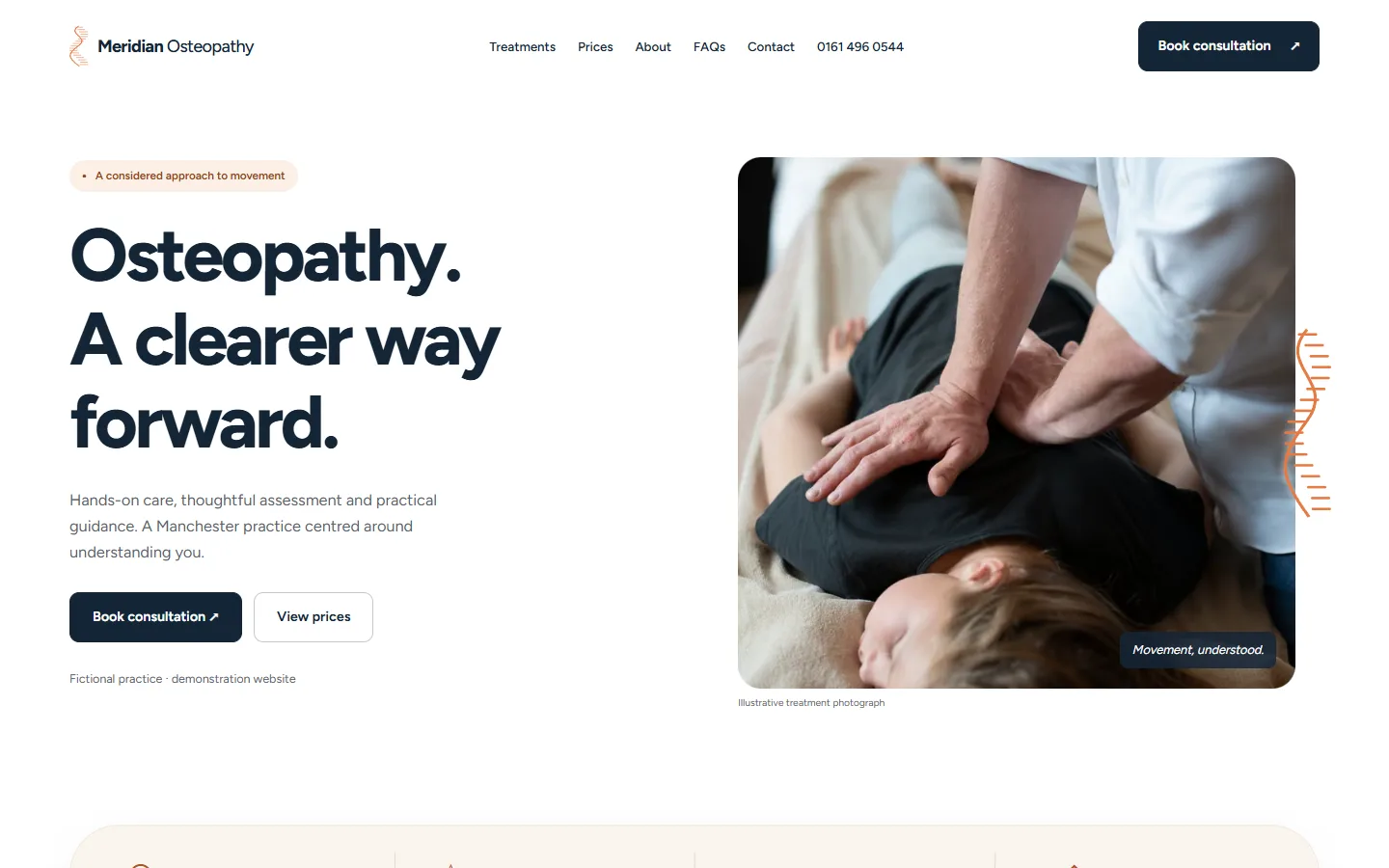
Meridian Osteopathy, a demo we designed and built for osteopaths. A fictional business, with illustrative photography.
Example site
An osteopathy practice website set in Manchester
- Four-step booking request
- Fee and length per appointment
- Consent on every service page
Demo website
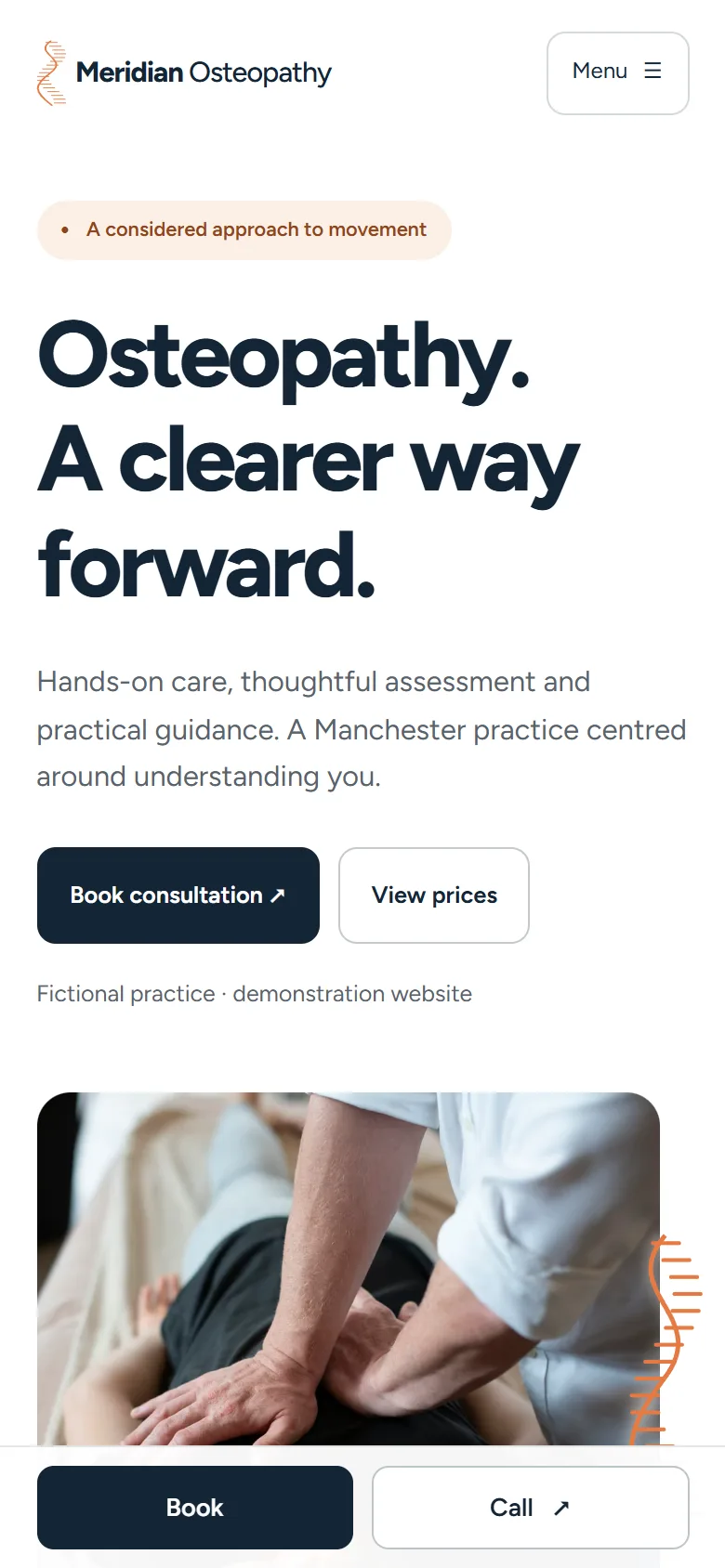
Meridian Osteopathy is a fictional business. We designed and built its website as a demo of how we build for osteopaths, using illustrative photography.
Open the live demo(opens in a new tab)01 / Booking request
Pick the appointment, then a preferred time
The request runs in four steps: the appointment, each shown with its length and fee, a preferred day and time, a name and one way to reply, then a check. It asks for no medical details, says preferred times are requests rather than live availability, and nothing is booked until the practice confirms.
Confirmed by the practice
02 / Consent
Consent and choice before any treatment
Each service page sets out the conversation, an assessment made with the patient's consent, and the options, with hands-on treatment as one of them. Patients are told they can pause or decline at any time, and the FAQs say no fixed course of appointments is promised.
Pause or decline at any time
03 / Claims
Appointments described, not outcomes promised
The demo has no condition pages and promises no outcome: its service pages describe what happens in the room, and every page links to NHS back pain guidance for urgent symptoms. The practitioner's profile carries the title osteopath beside a GOsC registration number, a sample on the demo.
No outcome promised
Built for osteopathy patients
What patients check, and what the rules allow.
A request form sized to the appointment
Initial consultation, follow-up or any other appointment you offer, then a preferred day and time and one way to reply. The practice confirms each request. Already on a practice management or booking system? Linking the site to it is checked and priced before the quote.
Your register entry, easy to match
Patients can search the GOsC register by town, postcode, surname or registration number. Your name as registered and your number on each profile make that search work, and the GOsC lets registrants show its Registration Mark on a website.
Condition pages from the ASA's list for osteopaths
The ASA and CAP accept osteopaths can claim to treat a set list, including sciatica, migraine prevention, rheumatic pain, and back pain not arising from injury or accident. Each page keeps the term as the list words it; anything outside it waits for robust clinical evidence.
Pregnancy and young patients, worded with care
The ASA says osteopaths may refer to treating pregnant women, children and babies, but claims about conditions specific to them, such as colic, are unlikely to be acceptable without a robust body of evidence. Its 2016 review gives example wording, and these pages are written from it.
No Dr without a medical qualification
The ASA's advice for osteopaths is to avoid Dr unless you hold a general medical qualification, and the GOsC's standards say a doctor title from a PhD should be made clear. Every profile is written to that from the first draft.
Fees and a complaints route patients can find
Each appointment with its length and price, how payment works and your cancellation terms. The GOsC's standards say clear fee information helps avoid disputes, and that patients should know how to complain and that they can take it to the GOsC. A short page covers both.
What patients search first
Patients compare before they book. Give them the facts.
Osteopathy website design aimed at the patient weighing up an osteopath against a chiropractor or a physio, and looking you up on the register before they call.
Comparing the professions
"Osteopath vs chiropractor" is searched about 3,600 times a month, "difference between osteopath and chiropractor" 2,900 and "osteopath vs physio" 1,300. A plain page on what your appointments involve answers them in your own words.
Looking you up on the register
"gosc register" is searched about 390 times a month and "osteopath register" 320. A profile showing your name as registered and your number makes that check quick.
Want ongoing support with Google Maps and local rankings?
Explore local SEO →Available separately from your website build.
Example local searches
- Osteopath vs chiropractor
- GOsC register
- Cranial osteopath near me
Search figures: DataForSEO, Google UK, 12-month averages, checked 3 November 2026.
Clear prices. Clear scope.
Fixed price. Agreed scope. No surprises.
Starter
From£295
One page for an osteopath working alone.
- Appointments, reviews and how to reach you, on a single page
- A request form that emails each booking request to you
- The website, its domain and the words stay yours
Essentials
From£595
Five pages for a practice with a small team.
- Home, appointments, about, reviews and contact
- Your GOsC number and mark placed where patients check
- A call button on every screen of the phone version
- Most popular
Business
From£995
For a practice with several services and practitioners.
- Everything in Essentials
- A page for each appointment type and patient group you see
- Structured data and the groundwork for local search
- Hosting and care included for year one
- All prices include VAT
- Hosting £15 a month, optional care £25 a month
- SEO plans from £100 a month
Business includes hosting and care for the first year. Or split any package into 12 interest-free monthly payments.
Prices last updated 24 September 2026. See full pricing and what each package includes
Your pages, features, price and timescale, agreed in writing before you pay.
How it works
From first chat to a website that works.
- 01
Brief
Send us the appointments you offer, who works in the practice and their GOsC numbers, your fees, any patient groups you see, such as pregnant women or children, and how patients book today. We agree the pages and a fixed price.
- 02
Build
The request form, condition pages drafted from the ASA's list, profiles that follow its advice on Dr, fees and a complaints page, all drafted with you. You approve every claim before it goes live.
- 03
Launch
We send a test request, look up each osteopath on the GOsC register by name and number, check every condition named against the ASA's list, and test each page on a phone before launch on a domain registered to you.
Your questions, answered
Questions osteopaths put to us.
Need a straight answer? Speak to us.
0161 399 4054What will my fixed quote include?
Your pages, the features on them, the final price and the timescale, in writing before you pay a deposit. Hosting, care and any ongoing SEO are listed separately, so you can see what is one-off and what is monthly. On the Business package the first year of hosting and care is included.
Patients ask whether an osteopath is a doctor. What should my website say?
That you are an osteopath on the GOsC register, without the title Dr unless you hold a general medical qualification. The ASA's advice for osteopaths says patients are likely to read Dr or Doctor as a medical qualification, so osteopaths without one should avoid it. If you hold a PhD, the GOsC's standards say you should make that clear. The ASA's PhD advice says a relevant PhD or doctorate is likely to be acceptable as Dr with the suffix PhD, that in health marketing the ASA would likely expect it qualified at once with a line that you hold no general medical qualification, and that the safest course is not to use the title. These rules apply across the UK.
Can my website say I treat babies, children or pregnant women?
Within limits. The ASA's 2016 review says osteopaths may make claims to treat pregnant women, children and babies "provided they are qualified to do so", but not conditions or symptoms presented as specific to those groups. Its osteopathy advice adds that claims about symptoms understood as specific to babies, children or pregnant women, such as colic or morning sickness, are unlikely to be acceptable without a robust body of evidence, and it has ruled against osteopaths' websites that made them. The review lists wording it is likely to accept, such as "Osteopaths treat people of all ages" and "Pregnancy can cause general aches and pains including joint and back pain and osteopathy could help", and says the same applies to patient testimonials.
Should my website explain how osteopathy differs from chiropractic or physiotherapy?
It helps: "osteopath vs chiropractor" alone is searched about 3,600 times a month in the UK (Google, checked 3 November 2026). Describe what your appointments involve, such as manual therapy, exercise and self-management advice, rather than ranking the professions. The GOsC's standards say comments about other healthcare professionals should be honest, valid and accurate, and any condition you name still comes from the ASA's list for osteopaths. The title rules differ too: a chiropractor's website may use Doctor of Chiropractic as a qualified courtesy title, while an osteopath's should avoid Dr.
Who on my team can be called an osteopath?
Only those on the GOsC register, whether their registration is full, conditional or provisional. Under section 32 of the Osteopaths Act 1993, which applies across the UK, describing yourself as an osteopath or any other kind of osteopath, expressly or by implication, is an offence unless you are registered. Implying it counts: the GOsC has prosecuted a non-registered person who implied they were an osteopath on their website, and it and the ASA treat unregistered people aligning themselves with the title as misleading. So if a sports massage therapist works with you, their profile should name their own qualification and leave the word osteopathic out.
What if a patient searches the GOsC register and cannot find me?
The GOsC tells patients that a missing result does not necessarily mean an osteopath is unregistered: the name may be spelt differently or may have changed. Patients can search by town or postcode, surname or registration number, and your entry shows your registration number and the years you qualified and registered. Put your name exactly as the register has it, and your number, on your profile, so a patient can search by either.
Should my fees page say what health insurance covers?
It should say what you can confirm and send the rest to the insurer. The GOsC tells patients that most major private health insurers cover osteopathy, but that they need to ask their own insurer about the level of cover, whether a GP or specialist referral is needed first, and whether their osteopath is covered. Your fees page lists each appointment with its length and price, how to pay and your cancellation terms, names only the insurers that recognise you, and points insured patients to those three questions. The GOsC's standards note that clear, visible fee information helps avoid disputes.
Let's build your next step
Want a practice website you can stand behind?
Send us your appointment list, your GOsC number and how patients reach you now. We reply with a fixed price and the pages we would build.