Pest control website design
Pest control website design that starts with the concern
Pest control website design is for firms whose customers often cannot name what is scratching behind the skirting board. UK searches for pest control near me average around 14,800 a month. The site should let someone choose rats, a wasp nest or not sure, show what each visit covers and leaves out, and answer the questions a careful household or a café owner asks before booking: why the products are professional only, which birds you may deal with, and what happens if bats share the loft.
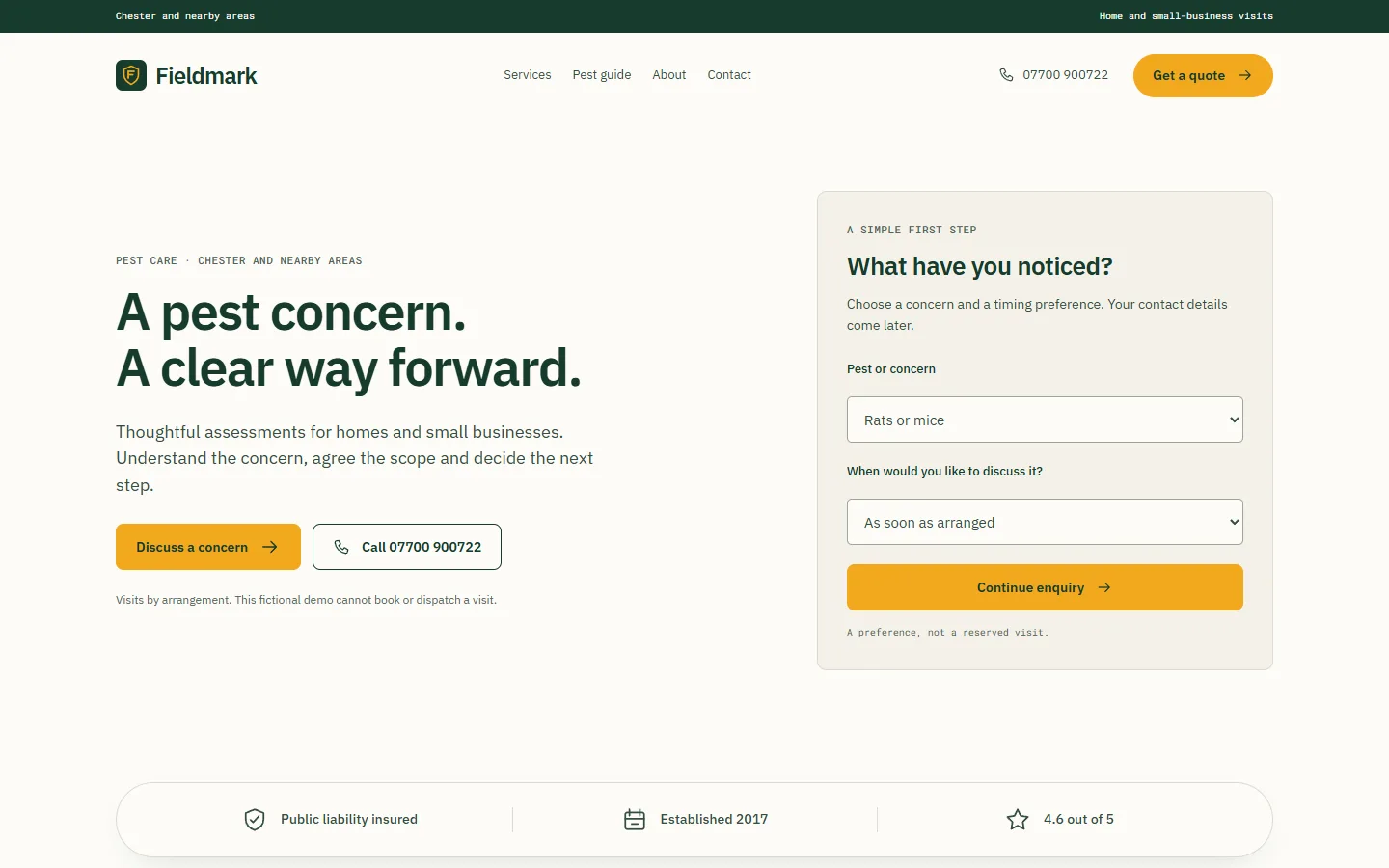
Fieldmark Pest Care, a demo we designed and built for pest control. A fictional business, with illustrative photography.
Example site
A pest control website for a small firm in Chester
- Four-step enquiry
- Scope and limits per service
- Two dated guides
Demo website
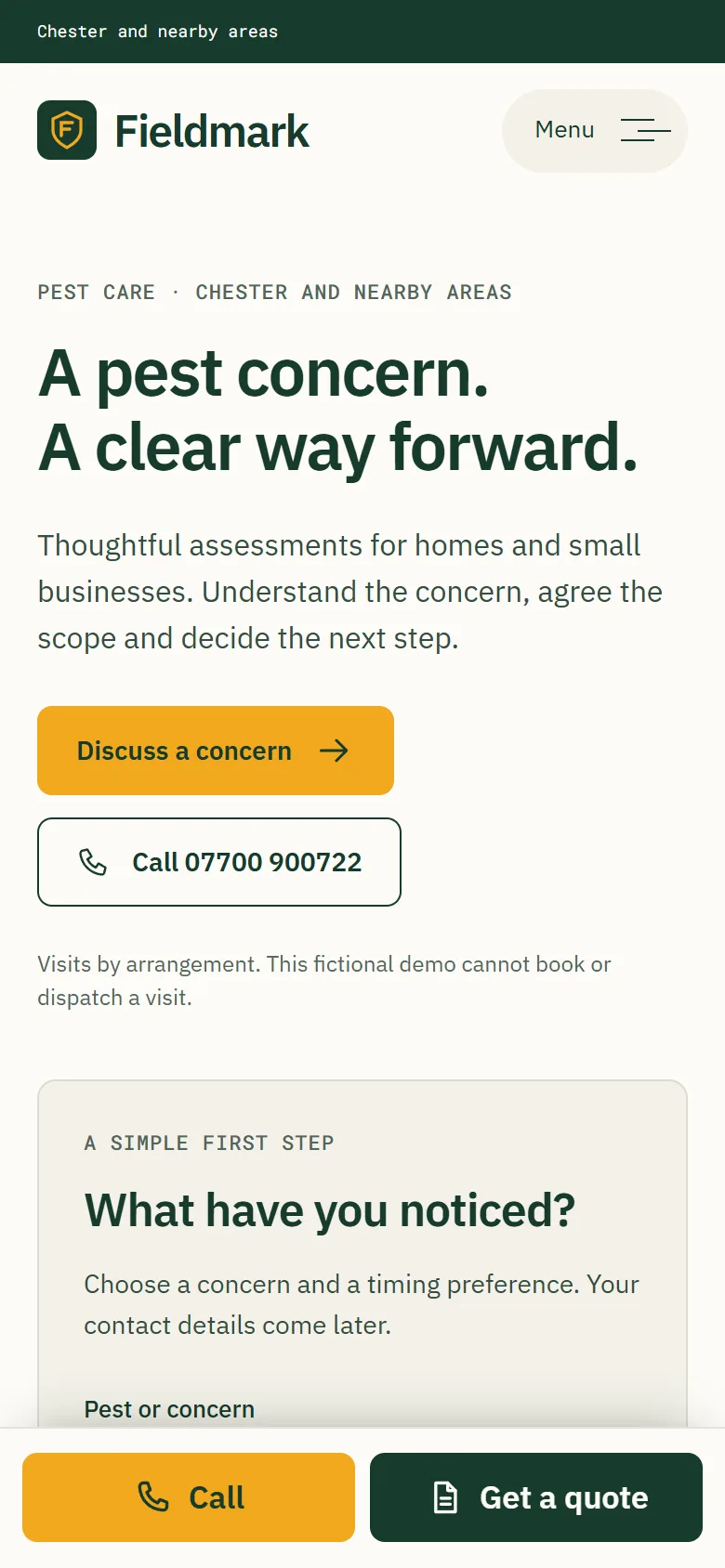
Fieldmark Pest Care is a fictional business. We designed and built its website as a demo of how we build for pest control, using illustrative photography.
Open the live demo(opens in a new tab)01 / Enquiry
Four steps, opening with what was noticed
The enquiry runs in four steps, "Concern", "Visit details", "Your details" and "Check". The first offers "Rats or mice", "A possible wasp nest", "Crawling insects", "A business premises" or "I am not sure yet", says "Not sure is a useful answer too." and asks "What kind of premises?" Visit details opens with "A postcode is enough to start.", and Check says "You can change any answer" before the visitor finishes.
Not sure counts as an answer
02 / Services
What each visit looks at, and what it leaves out
Rats and mice, wasp nest enquiries, crawling insect concerns and commercial pest checks each get a page with a list headed "What the assessment considers" and a box headed "Limits to understand". On the rats and mice page the box reads "Fieldmark does not promise full-building exclusion, a fixed number of visits or eradication."
Limits stated before booking
03 / Commercial and advice
Check intervals agreed after a survey
Under "Planned commercial checks" the steps are "Survey the premises", "Discuss the interval" and "Agree it separately". Two guides, "Before a pest inspection: the useful details" and "Reading a pest-control quote: ask about the scope", are each marked "Enquiry guide · 4 November 2026", and the advice page says "The pest notes help route an enquiry without asking you to make an identification."
Guides for the first call
Built for customers who are not sure what they have
What a customer weighs up before booking a pest visit.
First question: the pest, or not knowing yet
Rats or mice, a wasp nest, crawling insects, a business premises, or not sure. Then the postcode and how soon. A noise behind a wall is a fair answer, so nobody guesses a species just to get past the form.
Professional products, explained once
HSE says some rodenticides in Great Britain are sold to and used only by certified professionals, and that the public should never use professional-only products. One short paragraph answers the caller who asks why they cannot simply buy it.
Which birds you handle, nation by nation
General licences cover a short list of pest birds for set reasons, and the list differs between England, Wales and Northern Ireland. Name the birds you deal with and why, and what happens when a licence does not cover the job.
Bats looked for before a loft treatment
Natural England's guidance for England says chemical products cannot be used in or near a known bat roost with bats present. Say you search for droppings and other signs first, and stop the treatment when you find them.
Claims you can stand behind
Guaranteed, 100%, pet safe and eco all need evidence under the CAP Code, which covers your own site. Set out the method, the follow-up visits and what happens if activity carries on, rather than a promise about the result.
Visit reports a food business can file
Food businesses must have adequate procedures to control pests. A commercial page can say what each visit report records and how often visits run, without calling the report a certificate or an inspection pass.
Found by households and businesses with a pest problem
The scratching in the loft. The nest by the back door.
Pest control website design aimed at the customer comparing firms before anyone sets a trap.
Searches for a firm close by
Pest control near me averages about 14,800 UK searches a month, peaking at 27,100 in October 2025, and rat exterminator near me draws around 1,300.
Searches that follow the season
Wasp nest removal averages 6,600 a month, but reached 18,100 in August 2026 and fell to 880 in February. Bed bug treatment draws about 8,100 and mouse pest control 1,000, which is why each pest earns its own page.
Want ongoing support with Google Maps and local rankings?
Explore local SEO →Available separately from your website build.
Example local searches
- Wasp nest removal
- Bed bug treatment
- Mouse pest control
Searches per month: DataForSEO, Google Ads UK, 12-month averages to September 2026, with monthly figures where given; read 4 November 2026.
Clear prices. Clear scope.
Fixed price. Agreed scope. No surprises.
Starter
From£295
One page for a technician working alone.
- Your pests, reviews and number on one page
- Enquiries emailed to you and stored
- Site, domain and wording owned by you
Essentials
From£595
Five pages: the pests, the scope and the team.
- Home, pests treated, about, reviews and contact
- BPCA or NPTA membership shown, where you hold it
- Built for a phone, with your number a tap away
- Most popular
Business
From£995
A page for every pest, every town and the contract work.
- Everything in Essentials
- Rats, wasps, insects and commercial checks: a page each
- A written page for each town on your patch
- Photos and write-ups of proofing work
- All prices include VAT
- Hosting £15 a month, optional care £25 a month
- SEO plans from £100 a month
Business includes hosting and care for the first year. Or split any package into 12 interest-free monthly payments.
Prices last updated 24 September 2026. See full pricing and what each package includes
Your pages, features, price and timescale, agreed in writing before you pay.
How it works
From first chat to a website that works.
- 01
Brief
Tell us the pests you treat, which products your certificates cover, the birds you handle and in which nation, the towns you visit, any trade body membership and how enquiries reach you now. A written scope and a fixed figure come before any work starts.
- 02
Build
The enquiry, a page for each service with its scope and limits, the lines on professional products, birds and bats, and how your commercial visit reports work, all written with you. You approve every sentence, including each legal line and the nation it applies to.
- 03
Launch
We send test enquiries to each inbox, check each membership against the trade body's own search, read every legal line against its source with you, and complete the enquiry on a phone ourselves. Then it goes live on a domain registered to you.
Your questions, answered
What pest controllers ask us.
Need a straight answer? Speak to us.
0161 399 4054What will my fixed quote include?
Your pages, the features on them, the final price and the timescale, in writing before you pay a deposit. Hosting, care and any ongoing SEO are listed separately, so you can see what is one-off and what is monthly. On the Business package the first year of hosting and care is included.
Can a pest control firm remove pigeons and their nests?
Sometimes, under a general licence, and each nation sets its own. Wild birds and their nests are protected by law, and a general licence lifts that only for the birds and purposes it lists. In England, Natural England's GL41 for 2026 covers feral pigeon and Canada goose for public health and safety, and jackdaw and monk parakeet where nesting causes a safety problem; for jackdaws, reasonable efforts with lawful alternatives must come first unless they would be impractical, ineffective or disproportionate. In Wales, NRW's General Licence 002 covers feral pigeon only. In Northern Ireland, DAERA's TPG1 covers feral pigeon and jackdaw, and cannot be used on Sundays or from an hour after sunset to an hour before sunrise. In England, anything GL41 does not cover needs an individual licence from Natural England. Name the birds you deal with and the reason on the site. Nests in tree work are covered on our tree surgeon page.
How should a wasp page handle a loft where bats may roost?
That you look for bats before treating, and stop if you find them. Natural England's guidance for England says chemical products cannot be used in or near a known bat roost if bats are present, that a thorough search for signs such as fresh droppings comes first, and that householders should call the bat advice helpline before a chemical product is used near a roost. In England and Wales, the Conservation of Habitats and Species Regulations 2017 make it an offence to deliberately disturb a European protected species, which all bats are, or to damage or destroy its breeding site or resting place. Scotland's 1994 Regulations cover deliberate or reckless acts, and Northern Ireland has its own 1995 Regulations. Two lines on the wasp page are enough.
Can my website say a treatment is guaranteed or 100% effective?
Only with evidence in hand and wording that means what it says. The CAP Code covers your own website across the UK. It says claims a customer would take as objective need documentary evidence held before publication, and that the word guarantee must not be used in a way that could confuse consumers about their rights. CAP's advice separates offering a guarantee, such as a money back promise, from claiming a result is guaranteed, and says marketers who cannot guarantee results should be careful not to imply they can. Write down what a treatment includes, how many visits it covers and what happens if activity carries on.
Can I call my treatments pet safe or eco friendly?
Not without evidence, and some words are better left off. Under the CAP Code, which covers your own site across the UK, a claim such as pet safe needs evidence, environmental claims need a clear basis, and an absolute claim such as eco friendly needs a high level of substantiation. The Biocidal Products Regulation is stricter for adverts for biocidal products: they must carry the line "Use biocides safely. Always read the label and product information before use." and must not mention non-toxic, harmless, natural, environmentally friendly, animal friendly or anything similar. That is the GB Regulation in England, Scotland and Wales; the EU Regulation applies in Northern Ireland. Whether a pest firm's service page counts as such an advert is not settled, so describe what you do, such as where bait is placed and how it is secured, rather than how safe it is.
How much should the site explain about professional rodenticides?
Enough for a customer to see why the job needs you. HSE's guidance for Great Britain says professional pest controllers do not need a certificate of competence for biocides in general, but some rodenticides and metal phosphide products can only be sold to and used by professional users with demonstrated competence, who hold specific certification; members of the public should never use professional-only products. For professional anticoagulant and cholecalciferol rodenticides, HSE made compliance with UK rodenticide stewardship a condition of the products' authorisation. The Campaign for Responsible Rodenticide Use runs the stewardship regime, and its code, certification and point of sale checks are the scheme's own rules rather than law. HSE also says to consider non-chemical methods before chemicals, so a rats page can explain proofing and trapping alongside baiting.
Can I show BPCA or NPTA membership on the website?
Yes, while you hold it, and in a way a customer can check. Under the Digital Markets, Competition and Consumers Act 2024, in force across the UK since 6 April 2025, displaying a trust mark, quality mark or equivalent without the necessary authorisation, or falsely claiming approval or endorsement by a body, is unfair in all circumstances. Membership is the trade body's own scheme. Customers can look a company up by name on the British Pest Control Association's Check a Member page, or search National Pest Technicians Association members by postcode and pest type, so link to the right search and take the mark down if membership ends.
Let's build your next step
Want enquiries that arrive with the pest, the premises and the postcode?
Send us the pests you treat, the towns on your patch and how calls come in now. You get a written scope and a single fixed price back.