Therapist website design
Therapist website design for counsellors and psychotherapists
Therapist website design for counsellors and psychotherapists comes down to the first message. Around 33,100 searches a month in the UK look for a therapist nearby, and someone searching may be deciding whether to write to a stranger about something personal. Your website shows how you work, what sessions cost and which register you are on, then asks for a name, a way to reply and a starting point. The rest can wait for the call.
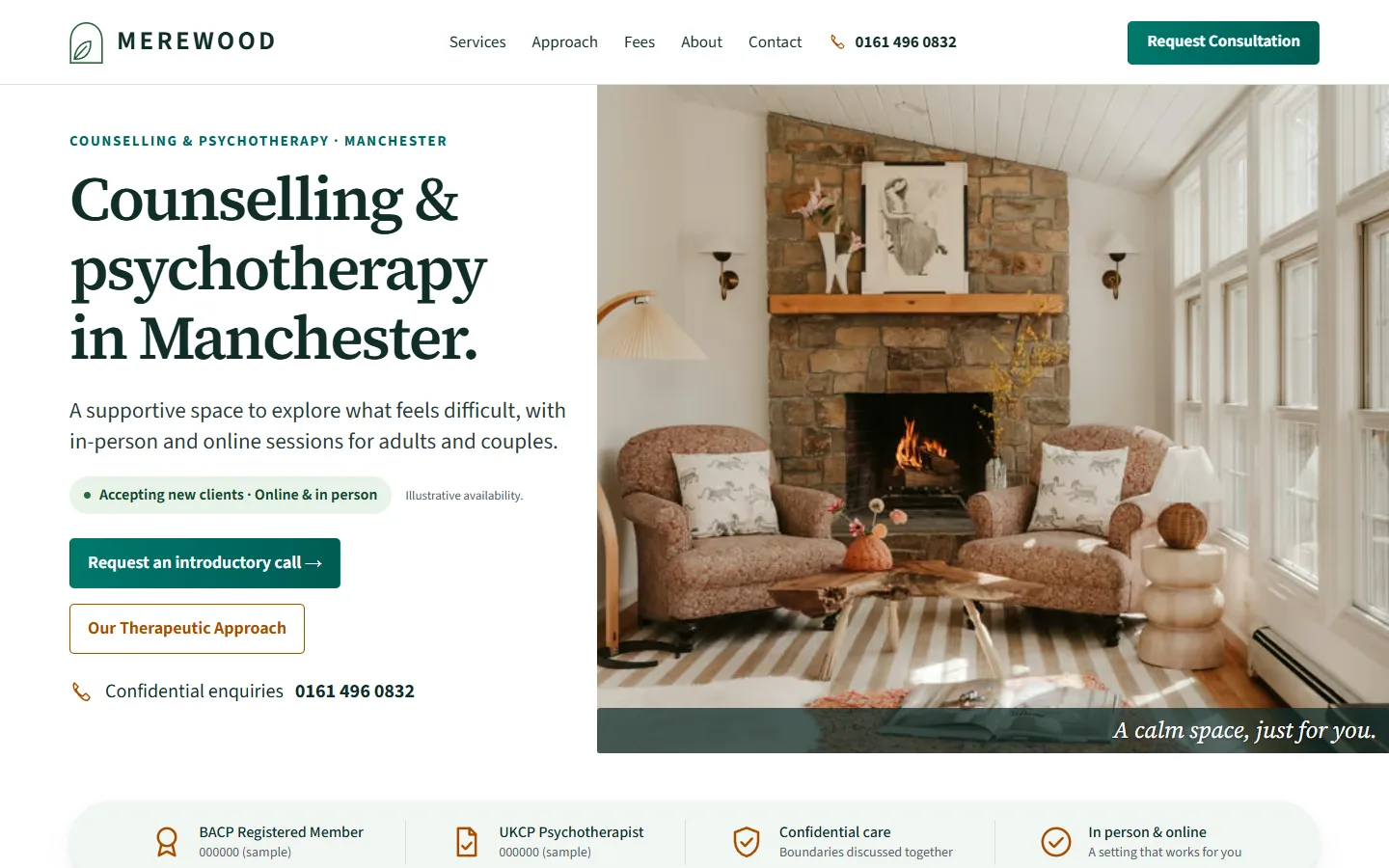
Merewood Counselling & Psychotherapy, a demo we designed and built for counsellors. A fictional business, with illustrative photography.
Example site
A counselling and psychotherapy practice, in Didsbury and online
- No health details asked for
- Sample registration numbers
- Fees for each kind of session
Demo website
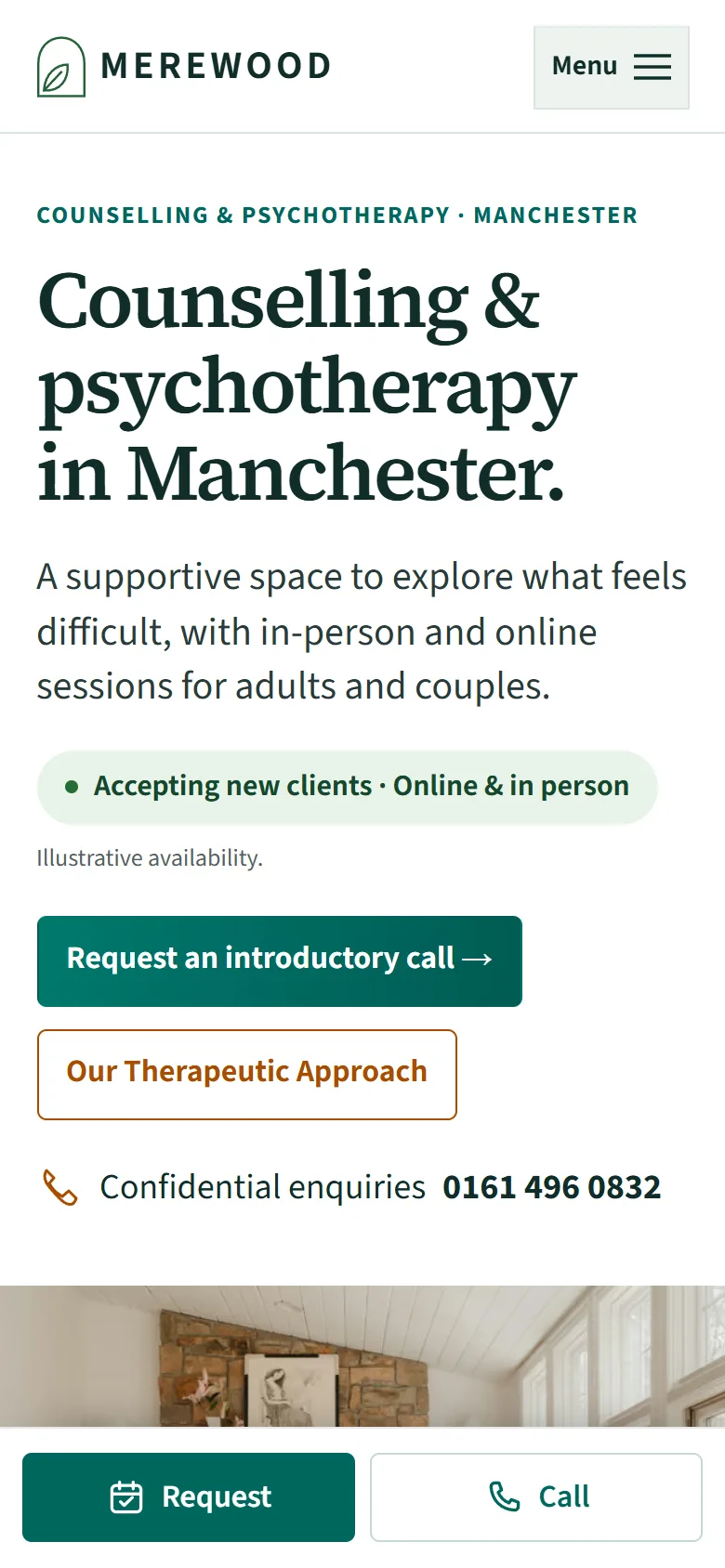
Merewood Counselling & Psychotherapy is a fictional business. We designed and built its website as a demo of how we build for counsellors, using illustrative photography.
Open the live demo(opens in a new tab)01 / First contact
A request that never asks for the story
Three steps: what the person would like to discuss (an introductory call, a question about sessions, fees, or something else), a name with a phone number or email, then a check before sending. The only free text is an optional short message, and the form asks people to leave medical and sensitive details out of it.
A starting point is enough
02 / Credentials
A number beside every credential
The homepage and About page each list a BACP and a UKCP registration number marked as samples, and the Team page shows the sample qualification with one combined sample BACP / UKCP number. The homepage says no real registration is claimed; About says the practice is fictional and not registered with a professional body. On a live site, those are the details a client matches against a register.
Samples, plainly labelled
03 / Sessions
Four ways in, each with its own page
Individual counselling, psychotherapy and trauma support, couples and relationship therapy, and online sessions each say what a session involves and promise no result or timescale. The fees page lists all four by length with a from price, notes concessions and mentions the free 15-minute introductory call.
Prices before the first call
For the person about to get in touch
What someone weighs before writing to you.
A consultation request, not an intake form
A first message needs a name, a way to reply and a starting point, and the form asks people to keep health details for the call. Linking an online booking or practice system is checked and priced before the quote.
Your register and number, as your body words them
BACP asks registered members to show their registration number on all promotional materials and sets the letters for each grade. Your profile carries the number, register and letters you actually hold.
Service pages that describe rather than diagnose
The ASA's advice on mental health claims names conditions, depression and eating disorders among them, that an ad may only claim to treat under a suitably qualified medical professional's supervision. Pages say what sessions offer instead.
Fees, lengths and concessions in plain sight
BACP's 2026 framework asks members to give clear information about fees, including when and how payments are made. A fees page sets out each kind of session, its length, any concessions and your cancellation terms.
A privacy page that matches the form
Mental health details are special category data under UK GDPR, and BACP asks for a clear, accessible privacy notice. Written with you, it says what the form collects and the limits of confidentiality.
Sessions in the room, online, or both
Online work gets its own page: a private space, a steady connection and what happens if the call drops, so someone outside travelling distance can see how sessions would run.
What clients search first
Searched for nearby. Looked up on a register.
Therapist website design for counsellors and psychotherapists, built around the client who searches locally and may look you up before writing.
Searches for a therapist nearby
Around 33,100 searches a month in the UK look for a therapist nearby and 8,100 for counselling nearby. Page one for 'therapist near me', read on 3 November 2026, is counselling and psychology practices, directories and the NHS talking therapies finder.
Searches on a register
The phrase 'bacp find a therapist' is searched around 5,400 times a month and 'bacp register' 1,900, a figure that includes members checking their own entry. Your number on the site lets a client match you to your entry.
Want ongoing support with Google Maps and local rankings?
Explore local SEO →Available separately from your website build.
Example local searches
- Counselling near me
- BACP find a therapist
- Couples therapy near me
Search figures: DataForSEO, Google UK, 12-month averages to September 2026, checked 3 November 2026.
Clear prices. Clear scope.
Fixed price. Agreed scope. No surprises.
Starter
From£295
One page: who you are, how you work, what it costs.
- Your services, fees and how to reach you on one page
- A short consultation request that emails you
- The site, the domain and the words are yours
Essentials
From£595
Up to five pages for individual, couples and online work.
- Home, services, fees, about you and contact
- Your register, grade and number beside your name
- A call button on every screen of a phone
- Most popular
Business
From£995
A page for each way you work, and care after launch.
- Everything in Essentials
- A page for each service, from individual work to couples
- Structured data describing the practice for search engines
- A year of hosting and care included
- All prices include VAT
- Hosting £15 a month, optional care £25 a month
- SEO plans from £100 a month
Business includes hosting and care for the first year. Or split any package into 12 interest-free monthly payments.
Prices last updated 24 September 2026. See full pricing and what each package includes
Your pages, features, price and timescale, agreed in writing before you pay.
How it works
From first chat to a website that works.
- 01
Brief
Tell us the ways you work (individual, couples, online), your fees and concessions, the register and grade you hold and how enquiries reach you now. Then we fix the scope and the price.
- 02
Build
Service pages, your profile with your registration number and letters as your register sets them, the fees page, the consultation request and a privacy page, written with you. You approve every line about what sessions offer.
- 03
Launch
Before launch, the request form goes through a test enquiry, your registration details are compared with your register entry and every fee with your current list. Each page is checked on a phone and published on a domain you own.
Your questions, answered
A few things counsellors and psychotherapists ask us.
Need a straight answer? Speak to us.
0161 399 4054What will my fixed quote include?
Your pages, the features on them, the final price and the timescale, in writing before you pay a deposit. Hosting, care and any ongoing SEO are listed separately, so you can see what is one-off and what is monthly. On the Business package the first year of hosting and care is included.
Can anyone call themselves a counsellor?
In law, yes, anywhere in the UK. The Professional Standards Authority lists counsellors among roles not legally required to be on a register, and says psychotherapists are not regulated by law but can choose to join an Accredited Register. Some neighbouring titles are protected, though: counselling psychologist and the other HCPC psychologist titles, and art psychotherapist, art therapist, dramatherapist and music therapist, need HCPC registration, and using one with intent to deceive is an offence. Your site uses only the titles you hold.
Can I list depression or anxiety on my services page?
Marketing on your own site is covered by the CAP Code, which the ASA applies across the UK. A claim that counselling treats or cures a condition needs robust evidence (rule 12.1). The ASA's advice on mental health claims, dated 15 July 2021, names serious conditions, among them depression, eating disorders, addictions and suicidal thoughts, where claims to treat, cure, diagnose or advise can only be made if the treatment is supervised by a suitably qualified medical professional; rule 12.2 lists the credentials CAP looks for. Anxiety is not among the conditions that advice names, though it calls CAP's list non-exhaustive, and a claim to treat or cure anxiety still needs robust evidence. CAP's own examples replace a condition claim with a line about how clients find sessions. Nothing goes live until you have read it.
Should my enquiry form ask what someone wants help with?
It does not need to. Under UK GDPR, details about a person's mental health are data concerning health, a special category: processing them needs a lawful basis and a separate condition, and the ICO says that if you can reasonably achieve your purpose without such data, processing it is not necessary. A first message only has to reach you. The form asks what the person would like to discuss, their name and a way to reply, and asks them to keep health details for the call, as the demo's form does.
Do counsellors need to register with the ICO?
If you keep client details on a computer or phone, its data protection fee is likely to apply. Across the UK, organisations that use personal information, sole traders included, must pay unless exempt, and the exemptions cover processing only for purposes such as accounts, staff administration or your own marketing, or without a computer, and a counselling practice is not processing only for those. Tier 1, for up to 10 staff or turnover up to £632,000, was £52 a year when we checked on 3 November 2026, £5 less by direct debit. The ICO's self-assessment gives the answer for your practice.
Can I put client testimonials on my counselling website?
Read your register's code first. UKCP's code says its registrants must not include testimonials from clients in any advertising, and UKCP's guidance says that covers your website. Whatever your register, the CAP Code holds any testimonial to strict rules: it must be genuine, used with permission and with contact details held, and it must not claim more for therapy than the ASA accepts. We build your pages around how you work and what a first session involves.
What should my profile say about my training and registration?
What you hold, in your body's own words. BACP asks registered members to show their registration number on all promotional materials and to use the letters set for their grade, such as Registered Member MBACP, and UKCP's code asks for a clear and honest statement of qualifications and registration. If your register is accredited by the PSA, you may show its Quality Mark, and the PSA asks you to display it when advertising. The ASA has upheld complaints from BACP about counsellors and therapists claiming membership, accreditation or a 'BACP qualified' status they did not have, most recently in August 2026. We check each line against your certificates.
Let's build your next step
Ready for a website that makes the first message easier to send?
Tell us the ways you work, your fees, the register you belong to and how enquiries reach you now. We reply with a fixed price and what it covers.