Air conditioning website design
Air conditioning website design for the June rush and the rest of the year
Air conditioning website design is for firms that fit split systems and air-to-air heat pumps in homes, offices and shops, air con and HVAC firms alike. UK searches for air conditioning installation average around 14,800 a month, but the figure reached 60,500 in June 2026 and fell to 3,600 in December 2025. So the site has two jobs: take the heatwave enquiry quickly, starting from what needs doing, and keep servicing and the heating side in view for the other months. On the way it settles what careful customers ask: who holds the F gas certificate, who signs off the new circuit, and whether the outdoor unit needs planning permission.
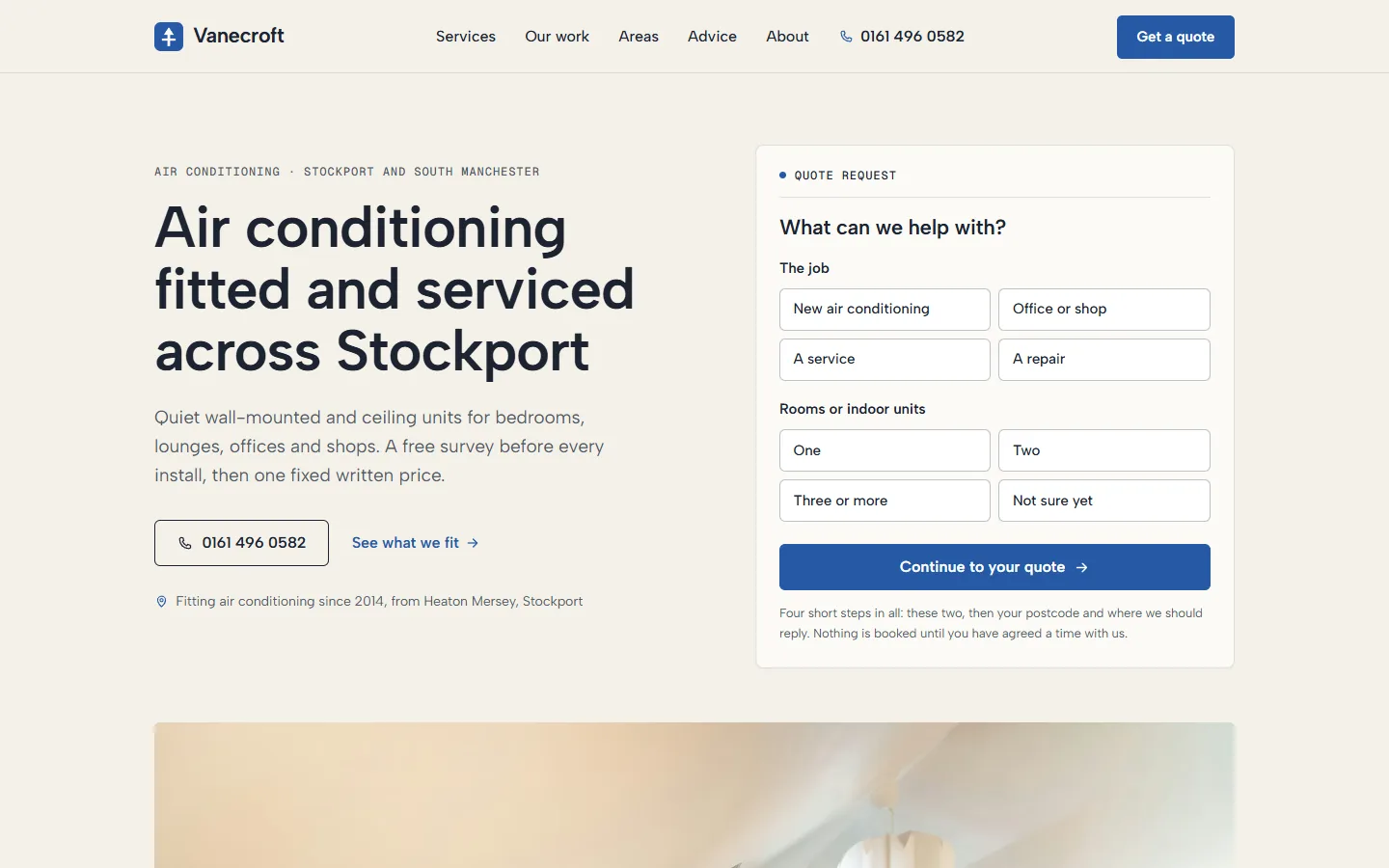
Vanecroft Air Conditioning, a demo we designed and built for air conditioning installers. A fictional business, with illustrative photography.
Example site
An air conditioning website for an installer in Heaton Mersey, Stockport
- Four-step quote request
- Guide prices with what is included
- Two guides with sources
Demo website
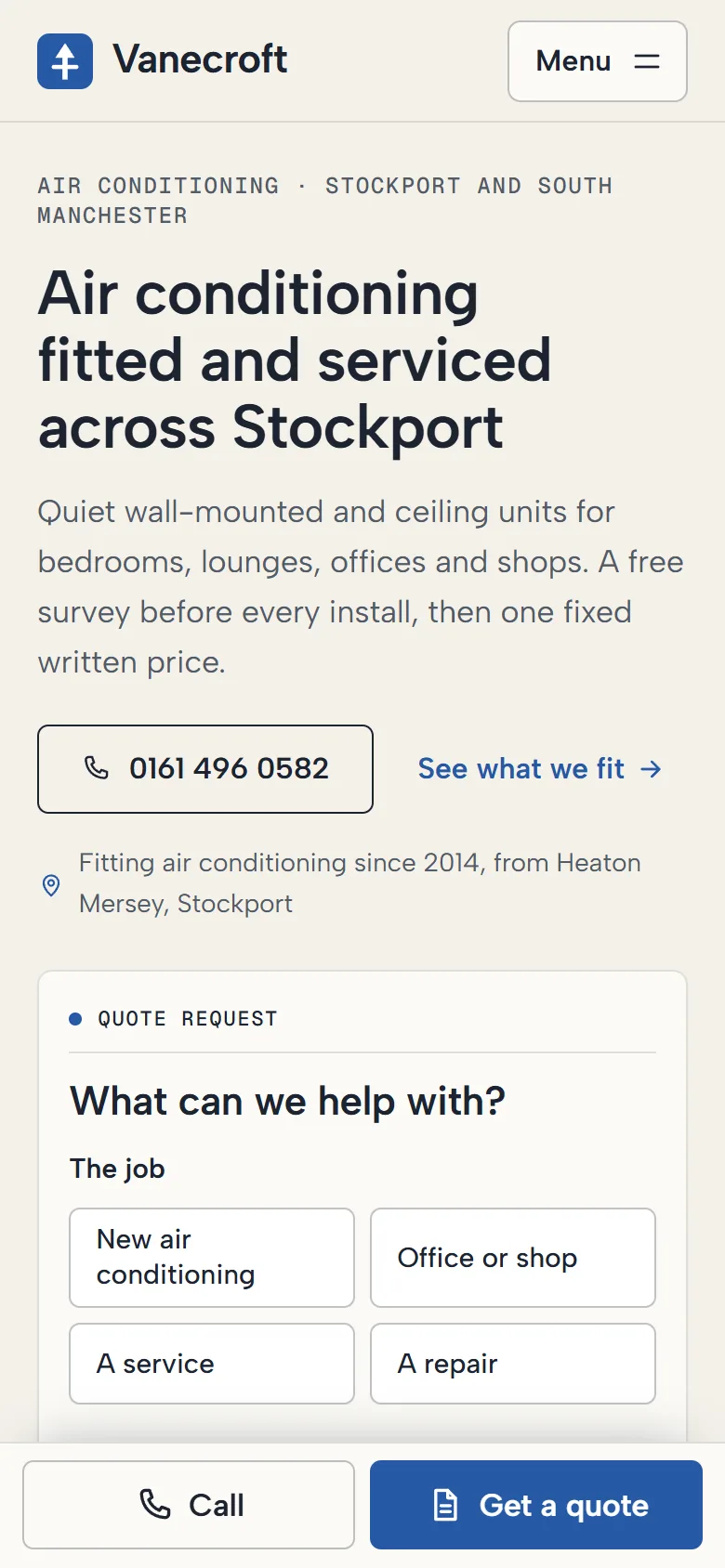
Vanecroft Air Conditioning is a fictional business. We designed and built its website as a demo of how we build for air conditioning installers, using illustrative photography.
Open the live demo(opens in a new tab)01 / Enquiries
Begin with what needs doing
Four short steps, headed 'The job', 'Where and when', 'Your details' and 'Check'. The first asks for the kind of job, from new air conditioning to a repair, and every answer is shown back with a link to change it before anything is sent.
The job comes first
02 / Prices
Guide prices that list their contents
A block headed 'Guide prices, fitted' carries the line 'Published so you know roughly where you stand before anyone visits', and each service page lists 'What you get'. Every figure on the demo is a sample for a made-up firm, and yours replace them.
Contents listed per price
03 / Guides
Planning and servicing, with the sources named
'Planning permission for air conditioning in England' and 'What happens at an air conditioning service' each end with the sources they were written from. Four service pages, sample F gas and Part P lines, three sample jobs and ten towns sit around them.
Sources on the page
Built for customers in a hot spell
What a customer checks before an air conditioning installer arrives.
An enquiry form built for the heatwave
New system, office or shop, service or repair comes first, then the postcode and how to reply. Short enough to finish on a phone, with nothing asked twice.
Both F gas certificates, named
In Great Britain each engineer needs a personal F gas certificate and the business, sole traders included, needs a company one. Show the company certificate number and the body that issued it.
Who signs off the new circuit
In England a new circuit is notified to building control or self-certified by a competent person scheme member. Name your scheme, or the electrician you work with. Wales keeps its own list.
Where the outdoor unit may go
England and Wales let a heat pump's outdoor unit go up without a planning application, within limits, unless it only cools. Scotland and Northern Ireland word it differently, so say which rules you work to.
Servicing that outlasts the summer
Searches for air conditioning servicing swing far less with the seasons than searches for installation. Servicing and repair pages, each saying what a visit covers, meet them all year.
The grant, in the scheme's own terms
In England and Wales the Boiler Upgrade Scheme lists £2,500 towards an air-to-air heat pump, claimed only by an MCS certified installer (GOV.UK, November 2026). Certified? Say so. If not, leave it out.
Found by households and offices in a hot spell
The loft bedroom in June. The office unit in March.
Air conditioning website design that serves the customer searching mid-heatwave and the one booking a service once it has passed.
Searches that follow the weather
Air conditioning installation averages about 14,800 searches a month in the UK, from 60,500 in June 2026 down to 3,600 in December 2025. Air conditioning near me averages 6,600.
Searches that carry on through winter
Air conditioning service averages around 4,400 a month, and air to air heat pump 8,100, a phrase that never dropped below 3,600 in any month. Pages for servicing and for heating catch both.
Want ongoing support with Google Maps and local rankings?
Explore local SEO →Available separately from your website build.
Example local searches
- Air conditioning service
- Air to air heat pump
- Air conditioning installation cost
Search figures: DataForSEO, Google Ads, United Kingdom, twelve-month averages to September 2026 and single months where named; read 4 November 2026.
Clear prices. Clear scope.
Fixed price. Agreed scope. No surprises.
Starter
From£295
One page for an engineer and a van.
- What you fit and service, with reviews and your number, on one page
- Enquiries land in your inbox and are stored
- Tap to call from any screen
Essentials
From£595
Five pages for a team of installers.
- Home, installs and servicing, about, reviews, contact
- F gas and electrical credentials where customers look
- Your Google reviews on the site
- Most popular
Business
From£995
Room for homes, offices, servicing and towns.
- Everything in Essentials
- Homes, offices and shops, servicing, repairs: a page each
- A page for each town, written for that town
- Hosting and care for year one
- All prices include VAT
- Hosting £15 a month, optional care £25 a month
- SEO plans from £100 a month
Business includes hosting and care for the first year. Or split any package into 12 interest-free monthly payments.
Prices last updated 24 September 2026. See full pricing and what each package includes
Your pages, features, price and timescale, agreed in writing before you pay.
How it works
From first chat to a website that works.
- 01
Brief
Tell us what you fit and service, the guide prices you charge and their contents, the towns you work in, your F gas certificate numbers, who notifies the electrical work, whether you hold MCS certification and how enquiries reach you today. Scope and price come back fixed and in writing.
- 02
Build
The enquiry form, a page per job type, the guide prices, your certificates and the planning and servicing guides, written with you for the nation you work in. You approve the wording of every rule.
- 03
Launch
Test enquiries go to every inbox, we check your company F gas certificate details with you, read each guide price against your own list and work through the form on a phone. Then the site launches on a domain you hold.
Your questions, answered
What air conditioning installers ask us.
Need a straight answer? Speak to us.
0161 399 4054What will my fixed quote include?
Your pages, the features on them, the final price and the timescale, in writing before you pay a deposit. Hosting, care and any ongoing SEO are listed separately, so you can see what is one-off and what is monthly. On the Business package the first year of hosting and care is included.
Does a customer need planning permission for the outdoor unit?
Often not, but each nation sets its own conditions. In England, since 29 May 2025, an air source heat pump on a house or block of flats is permitted development within limits, as long as it "is not solely used for the purpose of cooling": one unit, or two on a detached house, an outdoor unit no bigger than 1.5 cubic metres on a house or 0.6 on a block of flats, passing the MCS 020 sound calculation, with none on a listed building and tighter rules in conservation areas. Wales adopted the same cooling condition on 1 June 2026, with 1 cubic metre on a block of flats. Scotland's condition is that the pump is "used only for the purpose of providing domestic heating or hot water", so check a unit that also cools with the council first. Northern Ireland's right covers one pump in the grounds of a house, not on a roof, that provides heat. As worded, a unit that only cools is outside all four rights.
Is there still a 1 metre rule for outdoor units?
Not in England. Its permitted development right used to bar any part of a heat pump within 1 metre of the property boundary, and that limit went on 29 May 2025. The current Welsh and Scottish rights set no boundary distance; Scotland's 1 metre is how far the unit may stand out from the wall or roof. Northern Ireland keeps one: no part of the pump within 1 metre of the boundary of a neighbouring house's garden. Every right still has siting limits and an MCS standard (or, in Scotland and Northern Ireland, an equivalent) to meet, so a page on where the outdoor unit will sit earns its place.
Who needs F gas certification: me, my engineers or the company?
In Great Britain, both people and business. Each engineer who installs, services, repairs or decommissions a system, or recovers its refrigerant, needs their own certificate in the right category, and an employer must make sure they hold it; a trainee enrolled on a course can work under a certificate holder's supervision for up to 24 months in total. The business, sole traders included, needs a company certificate to do that work for customers, from one of the bodies GOV.UK lists (Refcom, F-Gas Register or Bureau Veritas), renewed every three years. The company certificate carries a number, the holder's name and the activities it covers, which is what your site can show. Northern Ireland is part of the EU's F gas system, so check the rules there with DAERA.
Can customers get the Boiler Upgrade Scheme grant on air-to-air systems?
In England and Wales, yes, through an MCS certified installer. GOV.UK lists £2,500 towards an air-to-air heat pump (read 4 November 2026); the installer makes the application and the grant comes off the quote and the invoice. Ofgem's conditions include that the system replaces fossil fuel or electric heating rather than a low-carbon system, that the heat pump is sized to meet the property's full space heating needs, and that air-to-air grants are not available for non-residential buildings. There is one grant per property, and the scheme does not run in Scotland or Northern Ireland. Offer the grant on your website only if you hold MCS certification, and show it beside the offer.
Is a yearly air conditioning service a legal requirement?
Two legal duties apply to some systems, and both sit with whoever runs the system, not the installer. In Great Britain, equipment holding F gas equal to 5 tonnes of carbon dioxide or more must be leak checked by a certified engineer at least every 12 months, or every 24 months with a leak detection system, and more often from 50 tonnes. In England and Wales, a system rated over 12 kW, including several small units whose combined output passes 12 kW, must be inspected by an energy assessor at intervals of no more than five years. For a system under both thresholds the sources we read set no interval, so your servicing page should say what you recommend and which duty a visit covers.
Can my prices say 0% VAT?
For homes, they may. HMRC's notice on energy-saving materials zero-rates installing permanently fixed air source heat pumps in residential accommodation until 31 March 2027, after which the reduced rate of 5% applies, and says its understanding is that most air conditioning units are air source heat pumps, with doubtful cases decided on the facts (VAT Notice 708/6, read 4 November 2026). Portable units do not qualify, and the relief covers residential accommodation and charitable buildings, so an office or shop install is outside it. Say on each price whether VAT is included and at what rate, and check a doubtful product with HMRC or your accountant before you advertise it.
Let's build your next step
Want enquiries that name the job before you ring back?
Tell us what you fit and service, whether you hold MCS, where you work and how enquiries arrive now. The price comes back fixed, in writing, with the pages listed.